 how-to
Preventing Supply Chain Delays in Commercial Printing
Table of Contents
- Assess Your Supply Chain Risks and Visibility
- Implement Print Production Lead Time Optimization
- Strategies for Inventory Management in Commercial Printing
- How to Reduce Print Order Turnaround Time
- Automate Workflows to Mitigate Material Shortages
- Managing Print Vendor Relationships for Supply Chain Resilience
- Communicate Delays and Build Contingency Plans
- Frequently Asked Questions
Last Updated: September 19, 2026
Assess Your Supply Chain Risks and Visibility
The first step in preventing supply chain delays in commercial printing is understanding where your vulnerabilities actually are. Most businesses don't know what's happening in their supply chain until something breaks.
Map your entire supply chain from raw materials through final delivery. Document every supplier, facility, and transportation leg. Identify hard-to-source materials, longest lead times, and workflow bottlenecks.
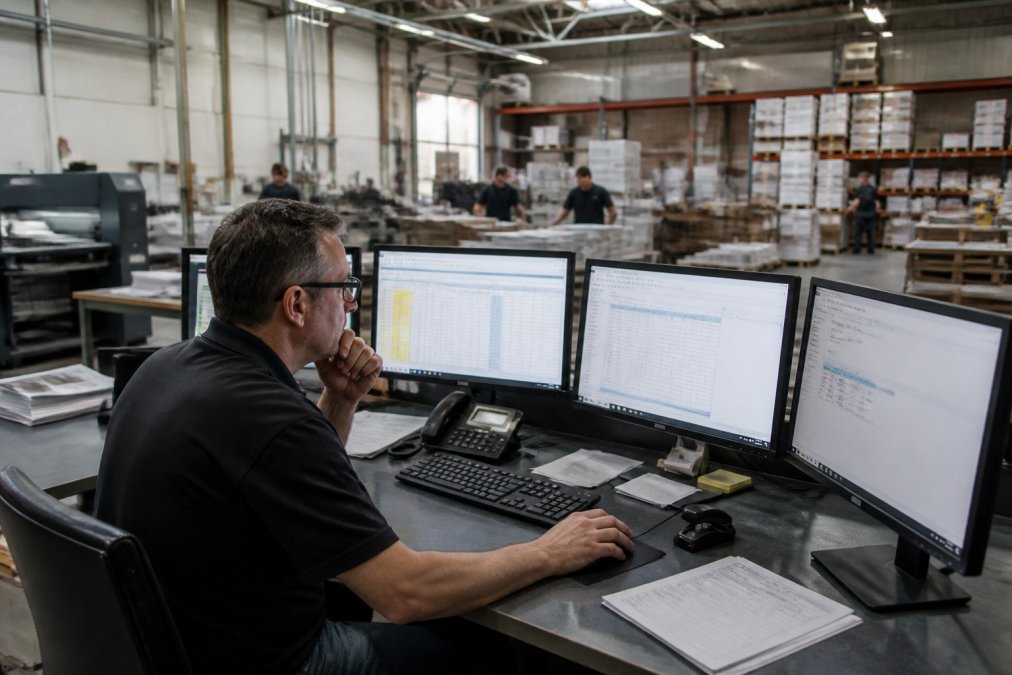
This visibility lets you act before problems happen. At American Printing Services, LLC, our network of production facilities across North America gives us real-time sight into capacity and material availability.
Key visibility steps:
- Track lead times for every material and supplier
- Monitor production capacity at each facility
- Document your current inventory levels
- Identify single points of failure
- Measure how long each production step actually takes
Once you see your risks clearly, you can build defenses against them.
Implement Print Production Lead Time Optimization
Print production lead time optimization means understanding exactly how long each step takes and removing waste. It requires predicting demand accurately to avoid over-ordering (which ties up cash) and under-ordering (which creates stockouts).
Work backward from your deadline. Map each step: design approval, material sourcing, printing, finishing, delivery. Each step has a minimum time you cannot compress, but most have hidden slack, unnecessary setup time, materials waiting between processes, finished goods sitting in warehouses.
Layer in demand forecasting. Most print shops quote standard lead times without anticipating demand patterns, spikes before trade shows, holidays, product launches, or seasonal campaigns.
AI-driven demand forecasting tools analyze historical order data, seasonal patterns, and external signals to predict future demand.
Pre-position materials before demand spikes. If forecasting predicts a 40% surge in Q4, order materials in Q3 at normal lead times instead of expediting in Q4 when lead times double.
Optimize batch sizes and production scheduling. Pre-print high-demand items and keep them in inventory, reducing lead time from 10 days to 2 days. Keep lower-demand items print-to-order.
Reduce approval cycles by anticipating content. If forecasting predicts a client will order their annual report in March, start the design and approval process in January so design is approved and materials are sourced before the formal order arrives.
Prevent over-ordering of slow-moving materials. Forecasting identifies infrequently ordered materials. Print-to-order instead of keeping safety stock, accepting a longer lead time for predictable, infrequent demand.
Where to find optimization opportunities using forecasting:
- Analyze order history by product, client, and season to identify consistent patterns.
- Identify lead time bottlenecks and pre-stage longest-lead steps before orders arrive.
- Batch similar orders to minimize setup time between runs.
- Route orders to nearest facilities based on predicted demand distribution.
- Pre-position materials at production locations for high-demand items.
- Automate handoffs between design, production, and shipping.
Start with 12-24 months of historical order data: order date, product, quantity, material, and lead times. Feed this into a forecasting model and validate against the next 3 months of actual orders. Once accuracy reaches 80%+, use forecasts to guide material ordering and production scheduling.
Integrate forecasting with your ERP and order management systems. When a forecast predicts a demand surge, your system automatically increases safety stock, schedules production capacity, and alerts suppliers. By the time orders arrive, you're positioned to fulfill them faster.
Strategies for Inventory Management in Commercial Printing
Inventory management in commercial printing balances cash tied up in stock against the ability to fill orders quickly during demand spikes.
The strategy depends on your order patterns. If you print the same materials repeatedly, keeping stock makes sense. If you print custom orders with no repeats, stock becomes waste.
Analyze your order history. Materials reordered within 30 days are candidates for stock. Materials sitting months between orders should be printed on demand.
Inventory management approaches:
- Keep stock of high-volume, frequently ordered materials
- Print to order for custom or low-frequency items
- Use safety stock for critical materials with long lead times
- Position inventory at multiple facilities to reduce delivery time
- Review inventory levels monthly and adjust based on trends
American Printing Services, LLC's distributed network can help improve rush order fulfillment.
How to Reduce Print Order Turnaround Time
Reducing print order turnaround time requires removing delays before, during, and after production, not just asking your printer to work faster.
The biggest delay usually happens before printing starts: design revisions, stuck approvals, and material sourcing often take longer than actual printing.
Simplify approvals: use templates and pre-approved brand guidelines, require feedback within 24 hours, and designate a single decision maker.
Pre-order materials with long lead times the moment you know you might need them.
Turnaround time reduction tactics:
- Establish pre-approved design templates
- Set firm approval deadlines (24 hours maximum)
- Pre-order long-lead materials before you have firm orders
- Use print-on-demand for small quantities instead of minimum orders
- Negotiate expedited shipping for time-critical orders
- Work with printers who offer rush production capacity
American Printing Services, LLC maintains production capacity for rush orders and handles simultaneous orders from multiple locations.
Automate Workflows to Mitigate Material Shortages
Automation prevents supply chain delays from becoming customer-facing problems by rerouting orders to alternate suppliers or facilities. You need print-specific logic that accounts for paper stock, specialty inks, and coatings.
Tie order management automation to material-level inventory tracking. When an order arrives, check availability by grade, weight, and finish. Flag shortages immediately and trigger backup protocols: substitute similar stock, source from secondary suppliers, or split orders across production runs.
Implement ERP integration for real-time visibility into inventory across all facilities and suppliers. ERP systems track material-specific lead times and automatically activate the right supplier based on your deadline.
EDI (Electronic Data Interchange) connections with suppliers let orders and inventory data flow automatically. Set up EDI feeds that include supplier inventory levels and production schedules so you can pre-position materials before shortages occur.
For paper and ink, establish a three-tier backup supplier protocol: Tier 1 (primary vendor), Tier 2 (alternate vendor, 5-15% premium), and Tier 3 (pre-approved substitute material). Automation activates each tier based on inventory and deadline constraints.
Document the substitution rules in your ERP system. For example: "If 80 lb. uncoated text is unavailable, 80 lb. smooth finish is an acceptable substitute with no design changes. If 4-color process ink is unavailable, spot color is acceptable with client approval within 2 hours."
Automation priorities for material resilience:
- Integrate order management with material-level inventory tracking (not just category-level)
- Set up automated reorder points for each material grade and supplier combination
- Use EDI for real-time supplier inventory and lead time feeds
- Automate order routing through your three-tier supplier protocol
- Create alerts for inventory below safety stock levels, segmented by material type
- Schedule production automatically based on available capacity and material availability
- Log every substitution decision so you can analyze which materials are most at risk
Workflow automation also protects you during demand spikes. When orders surge, automated systems allocate capacity across your production network and material inventory instead of letting one facility get overwhelmed or one material run out. The key is that your automation understands the constraints: not just "Do we have capacity?" but "Do we have the specific paper grade, ink color, and finishing capability this order requires?"
Test your automation quarterly by simulating a material shortage. Disable your primary supplier in the system and verify that orders automatically route to your secondary supplier. This testing catches gaps in your backup protocols before a real shortage forces you to improvise.
Managing Print Vendor Relationships for Supply Chain Resilience
Your vendors are your supply chain. If your vendor relationships are weak, your supply chain is weak.
Strong vendor relationships start with transparency. Share your forecast with your suppliers. Tell them when you expect demand spikes. Give them visibility into your inventory levels. When suppliers understand your business, they prioritize your orders and warn you about upcoming shortages.
Diversify your suppliers for critical materials.
Vendor relationship practices:
- Share forecasts and inventory plans with key suppliers
- Establish backup suppliers for critical materials
- Pay invoices on time to build goodwill
- Visit supplier facilities to understand their capacity and constraints
- Negotiate long-term contracts for stable pricing and priority access
- Provide feedback and collaborate on improvements
| Relationship Factor | Impact on Resilience | Action |
|---|---|---|
| Supplier diversity | High | Establish 2-3 suppliers per critical material |
| Communication frequency | High | Share forecasts monthly, inventory weekly |
| Contract terms | Medium | Lock in pricing and lead times annually |
| Payment reliability | Medium | Pay within agreed terms consistently |
| Facility visits | Low | Visit key suppliers annually |
Communicate Delays and Build Contingency Plans
Even with perfect planning, delays happen. When they do, how you communicate determines whether you keep the customer or lose them.
Contingency planning steps:
- Identify your top 5 supply chain risks
- For each risk, define your response (alternate supplier, alternate material, alternate facility)
- Document the response in writing
- Test the response at least once per year
- Review and update the plan quarterly
- Communicate the plan to your team and key suppliers
Frequently Asked Questions
What are the primary causes of delays in print production?
Material shortages, supplier lead times, production capacity bottlenecks, and inadequate demand forecasting are the most common culprits. Supply chain disruptions, whether from raw material scarcity, logistics delays, or equipment downtime, directly impact your print timelines. Real-time tracking and early risk assessment help identify problems before they cascade into missed deadlines.
How can I reduce print order turnaround time without sacrificing quality?
Optimize your lead times by streamlining order specifications, automating workflow handoffs, and maintaining buffer inventory for high-volume items. Partner with vendors who offer EDI integration for faster order processing. Digital printing solutions can accelerate short-run jobs, while maintaining clear communication with your vendor about priority orders ensures your deadlines stay on track.
How does vendor diversification help prevent supply chain delays in commercial printing?
Relying on a single supplier creates a single point of failure. When you diversify across multiple production facilities and suppliers, one delay doesn't halt your entire operation. A network approach, like American Printing Services' footprint, ensures backup capacity, reduces dependency on any one vendor, and provides geographic redundancy for faster delivery.
What role does inventory management play in preventing delays?
Strategic inventory of high-demand items (business forms, standard labels, common substrates) acts as a buffer against supply disruptions. Demand forecasting and ERP integration help you stock the right quantities at the right time. This prevents stockouts while avoiding excess inventory costs, balancing operational efficiency with cost optimization.