 how-to
How to Choose Fabrics for Custom Company Polos
Table of Contents
- Understanding Polo Fabric Composition and Performance
- Cotton vs Polyester Polo Shirts: Weighing the Trade-offs
- Piqué vs Jersey Polo Fabric: Construction and Feel
- Best Polo Fabric for Embroidery and Logo Customization
- Matching Fabric Choice to Workplace Conditions
- How to Care for Custom Polo Shirts and Preserve Quality
- Fabric Specifications and Quality Checks Before Ordering
- Frequently Asked Questions
Last Updated: October 18, 2026
Understanding Polo Fabric Composition and Performance
Choosing the right fabric for custom company polos affects comfort, longevity through repeated washing, and logo vibrancy.
Polo fabrics fall into three categories: pure cotton, pure polyester, and blends. Cotton breathes and feels soft. Polyester resists wrinkles, dries fast, and holds shape.
Fabric weight, measured in grams per square meter (gsm), matters too. Lighter fabrics (under 150 gsm) feel airy but wrinkle easily; heavier fabrics (180+ gsm) feel structured but warm.
Cotton vs Polyester Polo Shirts: Weighing the Trade-offs
Cotton: Breathability, Softness, and Maintenance
Cotton is the traditional polo choice. It breathes exceptionally well for warm climates and active work, and feels soft from day one, getting softer with every wash.
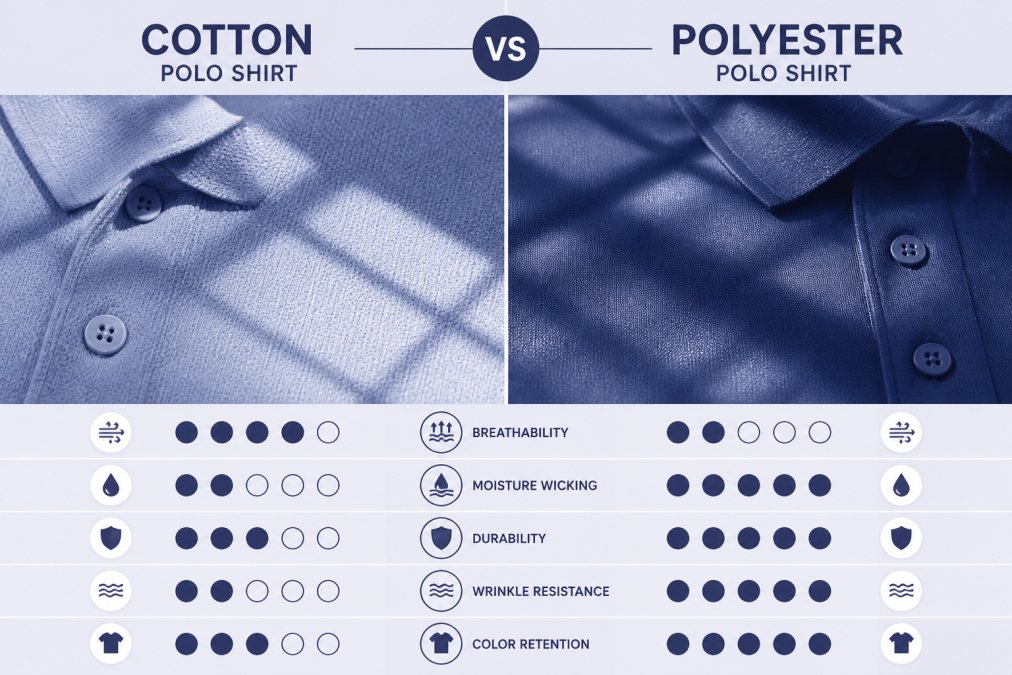
The downside: cotton wrinkles easily, shrinks if mishandled, and absorbs moisture, so wet spots show and drying takes longer.
Cotton-polyester blends at 60% cotton / 40% polyester offer a middle ground. You get most of cotton's breathability with improved wrinkle resistance and shape retention.
Polyester: Durability, Moisture-Wicking, and Shape Retention
Polyester excels at durability: it resists pilling, holds color, and keeps its shape through dozens of launderings.
The trade-off: polyester doesn't breathe as well as cotton, so some employees feel less comfortable in heat. Poor-quality polyester feels plasticky and shows wrinkles and pilling more than mid-to-high-grade versions.
High-quality polyester (180+ gsm) performs significantly better than budget options. The heavier weight creates a more substantial feel and resists pilling.
Cotton-Polyester Blends: Balancing Comfort and Performance
Blends are the most popular choice for custom company polos. A 65% cotton / 35% polyester blend balances cotton's softness and breathability with polyester's durability and wrinkle resistance. The 60/40 leans toward polyester performance; 70/30 favors cotton comfort.
Blends simplify care: they shrink less than pure cotton, dry faster than pure polyester, and resist pilling better than cheap cotton. For multi-location businesses, they reduce variability.
Piqué vs Jersey Polo Fabric: Construction and Feel
Piqué is the traditional polo fabric, woven with a raised, textured surface of small diamond or waffle-like patterns.
Jersey is a knit with a smooth, flat surface.
For custom company polos, piqué is the standard choice. It looks more polished and professional.
Most suppliers default to piqué. If your team works in high heat and prioritizes comfort over formality, ask about jersey, but expect less structure and more wrinkling.
Best Polo Fabric for Embroidery and Logo Customization
Decoration compatibility is where fabric choice meets production risk: a fabric that feels great can still produce puckered embroidery, poor print adhesion, or heat-damaged fibers. The guidance below covers what causes decoration failures and how to test before a bulk order.
Embroidery: Stitch Density, Backing, and Puckering
Embroidery pulls fabric around each stitch. The tighter the stitch density and the larger the design, the more the fabric must resist distortion.
- Fabric weight: Specify a minimum of 160 gsm for embroidery; 170+ gsm piqué is safer for designs wider than about 3 inches or with dense fill areas.
- Stitch density: Ask your decorator to keep stitch counts appropriate to the fabric. Very dense designs on lightweight fabric cause puckering that cannot be pressed out.
- Backing: A cut-away backing stabilizes stretchy or lightweight knits better than tear-away. For piqué, a lightweight cut-away is common; for jersey, a heavier cut-away may be needed to prevent the design from distorting the drape.
- Needle and thread: A sharp needle and a thread weight matched to the fabric reduce fiber damage. Ask the decorator to confirm the thread type and needle size for your specific fabric.
Screen Printing: Texture, Adhesion, and Color Variation
Screen printing on piqué is workable but less forgiving than on jersey. The raised texture prevents the squeegee from contacting every fiber evenly, causing slight color variation or a mottled look on large solid areas. Mitigations:
- Use a platen adhesive suited to textured knits so the garment stays flat during printing.
- Consider a higher mesh count for fine detail, or simplify very fine lines that the texture will obscure.
- Test print adhesion by stretching the printed area after curing; poor adhesion shows as cracking or flaking.
- For polyester-rich fabrics, confirm the ink chemistry is compatible with the fiber; some plastisol inks adhere differently to polyester than to cotton.
Heat-Sensitive Decoration Risks
Heat transfers, vinyl, and some screen-print curing processes expose fabric to high temperatures. Polyester is heat-sensitive: excessive heat can glaze the surface, set permanent wrinkles, or cause shrinkage. If your logo program uses heat-based decoration, ask the decorator to confirm the safe temperature range for your fabric and to test on a sample first. Cotton-rich fabrics tolerate higher heat but can still scorch.
Test Before You Commit
The single most effective risk control is a decoration sample on the exact fabric, color, and size you plan to order. Request at least three samples and evaluate them after five wash cycles:
- Check for puckering around embroidery edges
- Look for print cracking, fading, or edge lift
- Confirm the logo color still matches the approved standard
- Inspect the fabric behind the decoration for distortion or shine
Match Decoration Method to Fabric Family
- Piqué + embroidery: The most reliable combination for corporate polos. The structured surface supports stitches and hides minor distortion.
- Piqué + screen print: Workable for bold, simple designs; expect some texture show-through on fine detail.
- Jersey + embroidery: Softer drape but higher puckering risk; use cut-away backing and moderate stitch density.
- Jersey + screen print: The smoothest print surface; best for detailed or multi-color designs.
- High-polyester performance fabrics + heat transfer: Confirm heat tolerance and ink compatibility before production.
Ask Suppliers the Right Questions
Before approving a decoration run, ask your supplier or decorator:
- What is the recommended stitch density and backing for this fabric?
- Has this exact fabric and decoration combination been tested after laundering?
- What is the safe heat range for this fabric if heat-based decoration is used?
- What is the remedy if a production run shows puckering or adhesion failure?
Documenting these answers protects both your budget and your brand appearance.
Matching Fabric Choice to Workplace Conditions
Most fabric guides describe materials in isolation. A more useful approach is to score each fabric against the conditions your team actually works in, using the four factors below before requesting samples.
Build a Simple Condition Scorecard
Rate each factor on a 1-3 scale (1 = low, 3 = high) for your workforce, then total the score. The total points you toward a fabric family.
- Climate exposure: How much time is spent outdoors or in non-climate-controlled space? (1 = indoor office, 2 = mixed, 3 = mostly outdoor)
- Activity level: How physically demanding is the work? (1 = desk-based, 2 = light movement, 3 = heavy exertion)
- Uniform frequency: How many days per week is the polo worn, and how often is it laundered? (1 = 1-2 wears/week, 2 = 3-4, 3 = daily or near-daily)
- Appearance standard: How formal is the setting? (1 = casual, 2 = business casual, 3 = client-facing professional)
A total of 4-6 points favors lightweight cotton or high-cotton blends in jersey or lightweight piqué. A total of 7-9 points favors mid-weight piqué in a 60/40 or 65/35 cotton-polyester blend.
Translate Scores into Fabric Specifications
Once you have a score band, convert it into concrete specs to request from suppliers:
- Low band (4-6): 150-165 gsm, 100% cotton or 70/30 cotton-polyester, jersey or lightweight piqué. Prioritize softness and breathability; accept more frequent replacement.
- Mid band (7-9): 165-180 gsm, 60/40 or 65/35 cotton-polyester, piqué. This is the workhorse specification for most office, retail, and light-industrial programs.
- High band (10-12): 180-200 gsm, 50/50 or 40/60 cotton-polyester, piqué. Prioritize colorfastness, pilling resistance, and shape retention over initial softness.
Account for Indoor vs. Outdoor Transitions
Employees moving between air-conditioned interiors and hot exteriors are a special case. Pure cotton feels cool indoors but stays damp outdoors; high-polyester dries faster but feels clammy in still air. A 60/40 cotton-polyester blend in 170-180 gsm piqué is the common compromise. For heavy sweating, ask whether the polyester is moisture-wicking treated and whether that survives laundering.
Factor in Laundry Logistics
If you use a commercial laundry service, confirm wash temperature and detergent chemistry before selecting fabric. High-heat commercial cycles accelerate cotton shrinkage and set wrinkles in polyester. Ask for shrinkage data after five commercial cycles, not just home laundering. For in-house laundering, cooler water and low-heat drying extend garment life.
Set Minimum Performance Thresholds
Regardless of score band, require suppliers to meet baseline thresholds before you approve a bulk order:
- Shrinkage of no more than 5% after five home launderings (or the commercial equivalent)
- Colorfastness rated for at least 40 wash cycles
- Pilling resistance of grade 4 or higher on a standard pilling scale
- Fabric weight within ±5% of the specified gsm
These thresholds turn a subjective fabric conversation into a measurable specification you can hold suppliers to.
How to Care for Custom Polo Shirts and Preserve Quality
Proper care extends polo life significantly.
Polyester and polyester-blend polos tolerate warmer water (up to 160°F) but still benefit from low-heat drying; high heat damages polyester fibers and sets wrinkles permanently.
For embroidered logos, turn shirts inside out before washing to protect stitching from friction and detergent. Avoid bleach, which weakens fibers and fades colors.
Pilling is normal in lower-quality fabrics but can be minimized. Wash similar colors together to prevent color transfer.
Fabric Specifications and Quality Checks Before Ordering
Before committing to a large order, request a detailed fabric specification sheet from your supplier. This should include:
- Fiber composition (exact percentages of cotton, polyester, elastane)
- Fabric weight in grams per square meter (gsm)
- Construction method (piqué or jersey)
- Colorfastness rating (number of wash cycles tested)
- Shrinkage percentage after washing
- Thread strength for embroidery compatibility
Request sample shirts in your chosen fabric, color, and size.
Ask your supplier about their quality control process. Do they test every batch, or only random samples? How do they handle defective shipments?
Request a bulk sample order (25-50 shirts) before finalizing quantities.
Selecting the right fabric for custom company polos determines whether your branded apparel investment pays off.
Frequently Asked Questions
What is the best fabric for custom company polos?
The best fabric depends on your workplace conditions and priorities. Cotton-polyester blends (65/35 or 50/50) offer the best balance of breathability, durability, and ease of care for most corporate environments. Pure cotton excels in comfort and breathability but requires more careful laundering. Polyester dominates in moisture-wicking and shape retention for high-heat or frequent-wash scenarios. Request composition reports and fabric weight (measured in grams per square meter) from your supplier to compare quality before ordering.
Are cotton or polyester polo shirts better for work?
Cotton polo shirts feel softer and breathe better, making them ideal for office environments and professional settings where comfort matters. Polyester polo shirts resist shrinkage, pilling, and fading, and they dry faster, better for outdoor work, frequent laundering, or high-heat jobs. For most mid-sized businesses with mixed roles, a 65% cotton/35% polyester blend delivers both comfort and durability without the maintenance burden of pure cotton.
What fabric works best for embroidered company polos?
Piqué knit construction with a stable, tightly-woven surface is ideal for embroidery. Polyester-rich blends (50/50 cotton-polyester or higher polyester content) provide thread strength and prevent puckering during stitching. Avoid lightweight jersey knit or loose weaves, which can distort under embroidery tension. Request a colorfastness test and thread-retention sample from your printer before full production to confirm the fabric and thread combination won't separate or fade after repeated washing.
How do you keep custom polo shirts from shrinking or fading?
Wash in cold water and tumble dry on low heat to minimize shrinkage and color loss. Polyester-dominant blends shrink less than 100% cotton. Turn shirts inside out before washing to protect printed logos and embroidery. Avoid bleach and high-temperature drying. Ask your supplier for pre-shrunk fabric and colorfastness test results (AATCC standards) to confirm dye quality. Quality custom polos from reputable vendors are typically pre-treated to resist shrinkage and fading when cared for properly.