 ultimate-guide
How to Select a Commercial Printing Partner
Table of Contents
- Why the Right Commercial Printing Partner Matters
- Start With Your Commercial Printing Procurement Process
- Quality Assurance and Print Standards to Verify
- Offset Printing Services vs. Digital: What Your Project Needs
- Evaluating Turnaround Times, Pricing, and Capacity
- Your Print Vendor Evaluation Checklist
- Managing the Partnership: KPIs and Post-Project Review
- Conclusion: Choose a Partner, Not Just a Printer
- Frequently Asked Questions
Last Updated: September 9, 2026
Why the Right Commercial Printing Partner Matters
Choosing the wrong commercial printing partner can stall a product launch, delay critical business forms, or leave your brand looking inconsistent across locations. When marketing collateral, labels, and branded merchandise arrive late or off-spec, the cost is measured in missed deadlines and diluted brand equity, not just reprint fees. A reliable partner functions as an extension of your operations, ensuring every piece of printed material meets your standards for quality and timing.
At American Printing Services, LLC, we've spent over 20 years helping businesses avoid these disruptions. This guide walks through a commercial printing procurement process that moves beyond price comparisons to evaluate the factors that actually determine success: quality systems, production capacity, and supply chain reliability. The goal is to give you a repeatable framework for selecting a vendor who delivers consistency, not just printed sheets.
Below, we break down the process into a practical, step-by-step approach. You'll learn what specifications to define before you start, which quality standards to verify, and how to build a vendor scorecard that keeps your projects on track.
Start With Your Commercial Printing Procurement Process
Most procurement efforts fail before a single quote is requested because the buyer hasn't defined the project clearly enough to compare vendors accurately. The commercial printing procurement process should begin internally, with a detailed brief that covers quantities, timelines, and technical requirements. Without this, you risk comparing apples to oranges across bids and making decisions on incomplete information.
Define Print Specifications and Volumes First
Document your exact needs before contacting vendors. Specify the paper weight and finish, color standards, dimensions, and any bindery services or finishing options required. Clear specifications allow printers to provide accurate pricing and prevent misunderstandings during production.
Small-Batch vs. High-Volume Strategy
Determine whether your project fits a small-batch or high-volume model. Small runs suit promotional items, event materials, or variable data printing where personalization matters. High-volume work, such as national marketing campaigns or standardized business forms, benefits from economies of scale and dedicated production lines. A partner with a wide network can handle both, adjusting capacity to your order size without compromising turnaround time.
Quality Assurance and Print Standards to Verify
Quality assurance in commercial printing is not a single promise; it is a system of verifiable controls, standards, and checkpoints. A partner that cannot articulate their system in concrete terms is asking you to accept risk on their word. Your vetting process should confirm they operate with documented procedures that align with industry-recognized benchmarks.
Industry Standards and Certifications to Look For
While there is no single federal printing certification, several standards signal a mature quality program. Ask if the facility is certified under the GRACoL (General Requirements for Applications in Commercial Offset Lithography) or SWOP (Specifications for Web Offset Publications) programs. These are not government mandates but industry-developed specifications for color reproduction and proofing that many top-tier printers adopt (idealliance.org). For packaging or labels, a partner should be familiar with G7 calibration methodology, which is a modern proof-to-print color management process that ensures consistency across different presses and substrates.
Beyond color, verify their adherence to ISO 9001:2015 for quality management systems (iso.org). This is a globally recognized standard, and a printer's certification means their production processes are audited for consistency and continuous improvement. Do not just take their word for it; ask for a copy of their certificate and the scope of the certification. A printer who is certified for 'design and development of print products' is different from one certified only for 'sales of printed materials.'
The Proofing Process: More Than a Glance
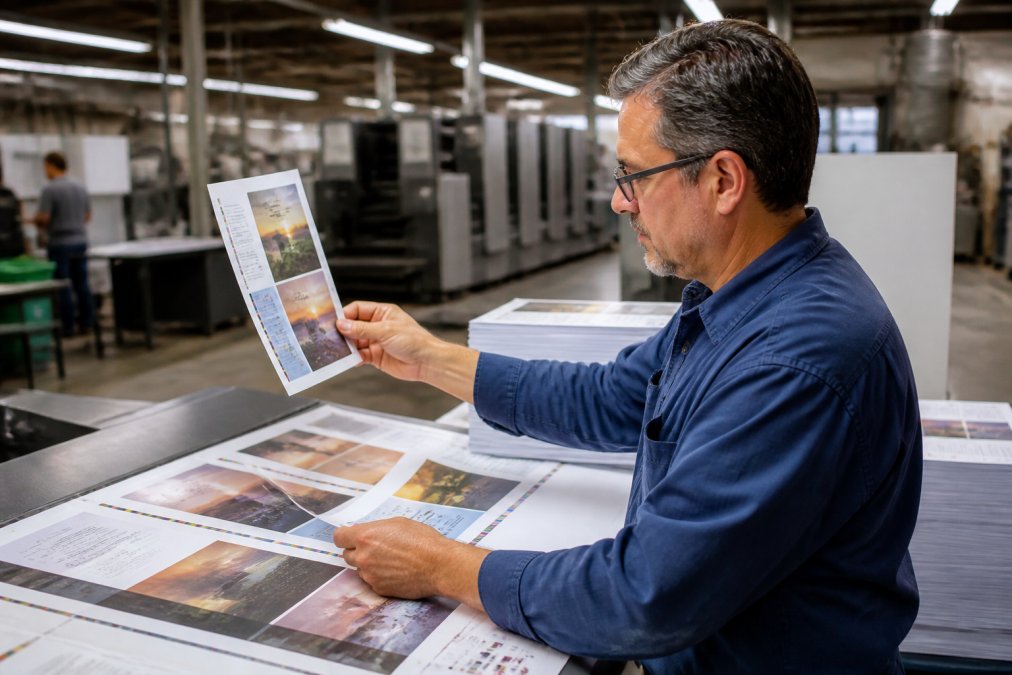
A proof is your last line of defense, but not all proofs are equal. A soft proof (a PDF) is useful for checking layout and content but is not reliable for color decisions because your monitor is not calibrated to their press. A hard proof (a physical print) is a better representation of the final output. For critical brand colors, ask if they provide a contract proof that is made on a calibrated proofer and comes with a color bar that can be measured with a spectrophotometer. This is not a standard courtesy; it is a quality control step that should be part of their workflow.
Your approval process should be formalized. The proof should be accompanied by a checklist that includes the job number, quantity, paper stock, and finishing specifications. When you sign off, you are approving the proof as the standard for the entire run. A professional partner will not proceed without this explicit sign-off and will archive the approved proof for future reference, which is critical for reorders.
In-Line and Off-Line Inspection Mechanisms
Ask about their inspection protocols. A high-volume printer should use automated systems, such as camera-based inspection on the press that scans every sheet for defects like hickeys, streaks, or color drift. For finishing operations, they should have checks for cutting accuracy, folding alignment, and binding integrity. Inquire about their defect rate and reprint rate, a mature partner will track these metrics and be able to share their performance targets. If a vendor cannot or will not discuss their internal quality metrics, it is a significant red flag. If a vendor cannot or will not discuss their internal quality metrics, it is a significant red flag.
Offset Printing Services vs. Digital: What Your Project Needs
The choice between offset and digital printing comes down to volume, cost per unit, and the level of detail required. Offset printing services remain the standard for high-volume runs because they deliver superior color accuracy and lower unit costs at scale. Digital printing offers faster setup and makes short runs and variable data printing cost-effective.
| Printing Method | Best For | Key Advantage | Watch Out For |
|---|---|---|---|
| Offset | High-volume catalogs, forms, packaging | Lower per-unit cost at scale | Higher setup cost for short runs |
| Digital | Short runs, personalized mailers, prototypes | Quick turnaround, no plates needed | Higher per-unit cost at volume |
| Hybrid | Multi-location brand collateral | Flexibility across order sizes | Requires a partner with both capabilities |
A vendor offering both technologies can recommend the most cost-effective method for each project rather than pushing you toward one press type. This flexibility is a strong indicator of a partner focused on your budget optimization, not just their own production schedule.
Evaluating Turnaround Times, Pricing, and Capacity
Pricing transparency matters, but the lowest bid can become the most expensive choice if the printer misses your deadline. Evaluate turnaround time promises critically. Ask for their standard production schedule, their process for rush orders, and how they handle capacity spikes during peak seasons. A partner with a broad network of production facilities can offer logistics management and nationwide delivery that a single-plant printer cannot match.
Request a detailed quote that itemizes printing, finishing, and shipping costs. Compare quotes based on total cost of ownership, including any freight or fulfillment services. If a price seems too low, question the paper quality or finishing options included in the quote. A professional partner will explain the trade-offs transparently.
Your Print Vendor Evaluation Checklist
A checklist is only useful if it forces a structured comparison. The goal is to move from a subjective 'gut feel' to an objective scorecard that weighs risks according to your business needs. The following framework is designed to be used as a scoring matrix, not just a list of yes/no questions.
Building a Weighted Scorecard
Before you start evaluating vendors, assign a weight to each category based on your project's priorities. For a regulated industry like healthcare or finance, Data Security and Compliance might constitute 30% of your total score. For a marketing agency, Technology and Capabilities might be more heavily weighted. A simple scoring system is to rate each vendor from 1 to 5 on each criterion, multiply that score by the category weight, and sum the totals for a final comparison.
| Category | Weight (%) | Vendor A Score (1-5) | Vendor B Score (1-5) | Vendor C Score (1-5) |
|---|---|---|---|---|
| Quality Systems & Certifications | 20% | |||
| Technology & Equipment | 15% | |||
| Data Security & Compliance | 20% | |||
| Pricing Transparency & TCO | 15% | |||
| Capacity & Scalability | 15% | |||
| Communication & Workflow | 15% | |||
| Total Weighted Score | 100% |
Deep-Dive Questions for the Scorecard
The questions below are designed to go beyond surface-level capabilities and probe for operational maturity.
Technology, Substrate Selection, and Finishing Options
- Press Technology: Do they have both sheet-fed and web presses? What is the maximum sheet size and color count (e.g., 8-color, 10-color with inline coating)?
- Digital Front End (DFE): What is their DFE? (e.g., a Fiery or Creo server). This impacts how they handle complex variable data and color management.
- Substrate Library: Do they stock common house sheets (e.g., a specific 100# gloss text) or must every order be a special order? Ask for a list of their standard stock.
- Finishing Capabilities: Are services like UV coating, aqueous coating, foil stamping, embossing, and perfect binding done in-house or outsourced? Outsourced finishing introduces logistical delays and potential quality control gaps.
- Pre-Press Support: Do they employ certified Adobe InDesign or Acrobat experts who can troubleshoot file issues, or do they simply reject files that do not meet their automated pre-flight checks?
Data Security, Compliance, and Workflow Integration
- Security Frameworks: Do they have a documented security policy that aligns with NIST (National Institute of Standards and Technology) guidelines (nist.gov)? While not a law, NIST compliance is a de facto standard for many enterprise vendors.
- Data Handling: For sensitive materials like HIPAA-covered documents or financial statements, do they have protocols for secure file transfer (SFTP), access controls, and secure destruction of obsolete materials? Ask if they are SOC 2 Type II audited, which verifies their controls over data security and availability.
- Workflow Integration: Can they accept orders via a web-to-print portal with an API that integrates with your procurement system (e.g., Ariba or Coupa)? This is a critical factor for reducing maverick spending and automating the reorder process.
- Service Level Agreements (SLAs): Does their SLA explicitly cover data breach notification timelines and liability? A generic SLA that does not address data protection is insufficient for enterprise risk management.
Managing the Partnership: KPIs and Post-Project Review
A print partnership requires active management. Establish key performance indicators (KPIs) at the outset, including on-time delivery rate, defect rate, and responsiveness to inquiries. Schedule a post-project review after the first few orders to assess performance against these metrics. This review should cover quality control results, adherence to the production schedule, and the accuracy of the final invoice.
Many businesses find that consolidating vendors into a single-source partner improves supply chain reliability. Managing one relationship simplifies project management and gives you more use for competitive pricing. American Printing Services, LLC maintains a network of over 2,500 production facilities across the United States, Canada, and Mexico, a scale that provides consistent supply and backup capacity when you need it most. This network allows us to handle rush orders for multiple locations simultaneously, a capability single-plant printers often lack. For businesses consolidating from three separate vendors, our onboarding process is designed to get the first order right quickly, minimizing the learning curve.
Conclusion: Choose a Partner, Not Just a Printer
Selecting a commercial printing partner is a strategic decision that affects your brand's consistency, your operational efficiency, and your bottom line. The right partner brings quality assurance, production capacity, and workflow integration to the table. They help you navigate small-batch versus high-volume strategy and provide the supply chain reliability that keeps your business running.
Don't settle for a vendor that simply prints on demand. Choose a partner that invests in your success with a documented commercial printing procurement process. With over 20 years of experience and a network of over 2,500 production facilities, American Printing Services, LLC provides the precision, speed, and nationwide delivery your business needs. Get started with American Printing Services, LLC and secure a partner who delivers on time, every time.
Frequently Asked Questions
What criteria should be used to evaluate a commercial printing partner?
Evaluate a commercial printing partner on five core criteria: quality assurance systems, technology and equipment capabilities, turnaround time reliability, pricing transparency, and customer service. Add data security and workflow integration for long-term partnerships. Ask for print samples, request a site tour, and check references from businesses with similar volume needs. A structured print vendor evaluation checklist helps you compare vendors objectively rather than on price alone.
What is the difference between digital and offset printing for business needs?
Offset printing services use plates and wet ink, producing the sharpest color accuracy for high-volume runs of brochures, catalogs, and branded collateral. Digital printing works directly from a file, making it faster and more cost-effective for short runs, variable data printing, and quick-turnaround projects. Many commercial printing partners offer both. Your choice depends on quantity, color requirements, and timeline.
How can a commercial printing partner help reduce long-term procurement costs?
A single commercial printing partner consolidates vendor management, reduces shipping costs, and gives you volume pricing leverage. They also prevent costly errors through pre-press file preparation and quality control. Look for a partner who offers a service level agreement with clear quality standards and turnaround commitments.
What questions should you ask during a print vendor site visit?
Ask about their quality assurance process between press runs, how they handle color management, and what their proof approval workflow requires. Ask for their service level agreement and how they measure on-time delivery. Ask about equipment maintenance schedules and press capacity during peak seasons.
How do you determine if a printing company has the right equipment for your project?
Ask which presses and finishing equipment they operate and whether they handle your required substrate selection in-house. For large-format or specialty work, confirm they have the specific print capacity and bindery services. Ask about maximum sheet size, coating options, and finishing capabilities.
Is print a declining industry?
No. While overall print volume has shifted, commercial printing remains a multi-billion-dollar industry in the United States. Packaging, labels, direct mail, and branded merchandise continue to grow. The key is finding a commercial printing partner who has invested in modern digital and offset printing services, not one relying on outdated equipment.