 ultimate-guide
Managing Print Logistics for Retail Chains: A 2026 Guide
Table of Contents
- Understanding Print Supply Chain Management for Retail
- Why Managed Print Services Matter for Multi-Location Retail
- Implementing Retail Print-On-Demand Solutions
- Print Supply Chain Management Best Practices
- Consolidating Vendors and Reducing Logistics Bottlenecks
- Ensuring Color Consistency and Quality Across Locations
- Scaling Print Logistics as Your Retail Chain Grows
- Frequently Asked Questions
Last Updated: September 30, 2026
Understanding Print Supply Chain Management for Retail
Managing print logistics for retail chains is fundamentally about orchestrating the movement of branded materials, point-of-sale collateral, and operational documents across multiple locations with precision and consistency. At American Printing Services, LLC, we've spent over 20 years helping retail operations simplify this complexity.
The print supply chain for retail extends far beyond simply ordering materials. It encompasses procurement strategy, inventory optimization, distributed manufacturing decisions, and fulfillment logistics that must work seamlessly across dozens or hundreds of store locations. When you're managing point-of-sale materials, window displays, employee uniforms, and business forms across a national footprint, the coordination challenge becomes exponential.
Most retail operations begin by treating each location independently. Regional managers order from local vendors, lead times vary, quality inconsistencies emerge, and costs multiply across redundant vendor relationships. This fragmented approach creates operational overhead that drains both budget and management attention.
The real opportunity lies in recognizing that managing print logistics for retail chains requires a fundamentally different approach than managing it for a single location. You need visibility across all locations, standardized quality control, predictable lead times, and the ability to scale production without creating bottlenecks. This is where strategic print supply chain management becomes a competitive advantage rather than a cost center.
Why Managed Print Services Matter for Multi-Location Retail
Managed print services function as a strategic outsourcing model where a single vendor assumes responsibility for your entire print production lifecycle, from design through delivery to your locations. For multi-location retail operations, this consolidation addresses a specific pain point: the coordination burden of managing multiple vendors, each with different quality standards, turnaround times, and pricing structures.
When you consolidate print procurement through a managed print services provider, you gain several operational efficiencies. First, you establish a single point of contact for all print-related decisions. Instead of coordinating with three vendors across five locations, you work with one partner who understands your brand standards and can execute consistently. Second, you create visibility into your actual print spending. Many retail chains discover they're spending more than necessary simply because different locations are ordering independently without volume consolidation.
The logistics advantage becomes apparent during peak seasons. A managed services approach means your vendor can distribute production across their network of facilities to avoid bottlenecks. If one facility reaches capacity during holiday promotional season, your order shifts to another facility within the network without disrupting your timeline. This distributed manufacturing approach is what separates a reliable partner from one that promises fast turnaround but misses deadlines when demand spikes.
Quality consistency is another critical benefit. When managing print logistics for retail chains, color matching across batches becomes essential. Your branded materials must look identical whether they're produced in facility A or facility B. A managed services provider implements standardized color management protocols, maintains consistent substrate specifications, and conducts quality audits across their production network to prevent the variations that damage brand perception.
Implementing Retail Print-On-Demand Solutions
Print-on-demand fundamentally changes how retail chains approach inventory management and fulfillment logistics. Rather than forecasting demand six months in advance and warehousing excess inventory, you produce materials as locations request them. This shift addresses a specific problem: inventory obsolescence.
Retail environments change constantly. Promotional campaigns evolve, seasonal messaging updates, and product assortments shift. Traditional warehousing locks you into decisions made months earlier. With print-on-demand integrated into your supply chain management, you can adjust messaging, update product photography, and respond to market conditions with lead times measured in days rather than months.
The implementation decision hinges on your production volumes and location distribution. High-volume, standardized items (business forms, standard labels, basic signage) still benefit from traditional centralized production. Customized or location-specific materials (promotional banners, event signage, regional messaging) thrive under print-on-demand.
Print Supply Chain Management Best Practices
Establishing best practices in managing print logistics for retail chains requires systematic attention to four core areas: procurement strategy, workflow automation, vendor consolidation, and supply chain visibility.
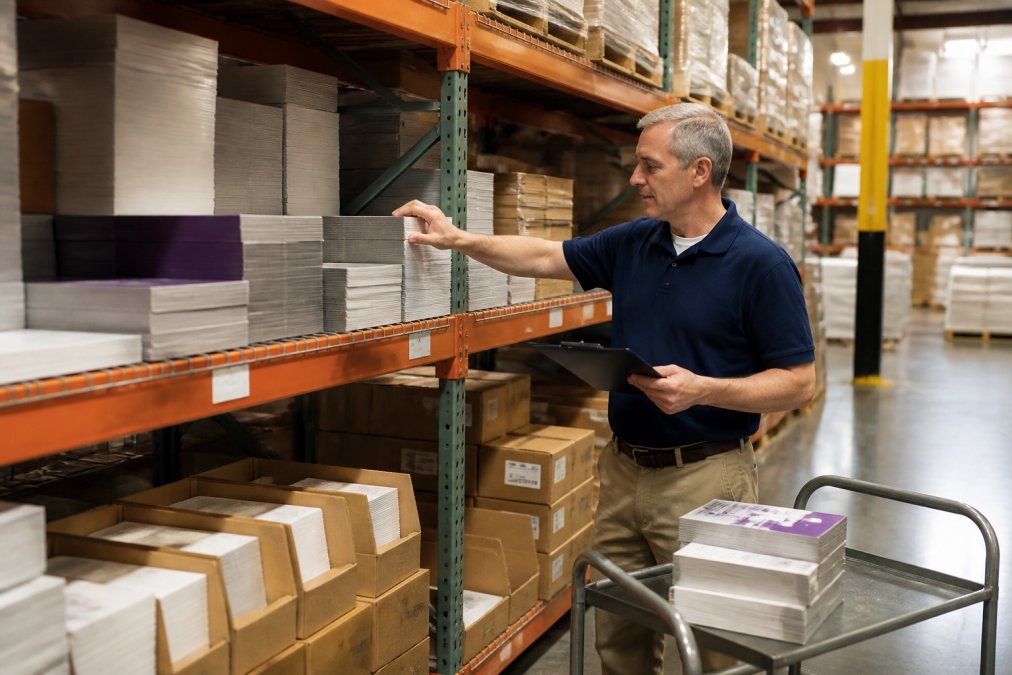
Consolidating Vendors and Reducing Logistics Bottlenecks
Ensuring Color Consistency and Quality Across Locations
Color consistency represents one of the most visible quality markers in retail environments. When your branded materials vary in color across locations, it damages brand perception and suggests operational carelessness. Managing print logistics for retail chains therefore requires rigorous color management protocols that ensure every piece produced matches your brand standards.
Scaling Print Logistics as Your Retail Chain Grows
Growth creates new complexity in managing print logistics for retail chains. As you expand from ten locations to fifty to one hundred, the coordination challenge multiplies. A print supply chain approach that worked at ten locations may collapse at fifty unless you've built scalability into your systems.
| Best Practice | Implementation | Expected Outcome |
|---|---|---|
| Procurement categorization | Assign items to centralized, managed, or on-demand production | Cost reduction through right-sizing production methods |
| Workflow automation | Integrate POS data with print ordering systems | Reduced manual errors and faster response to inventory needs |
| Vendor consolidation | Move from 3-5 vendors to 1-2 strategic partners | Simplified management and volume-based pricing use |
| Quality standardization | Implement color specs and audit protocols | Consistent brand presentation across all locations |
| Supply chain visibility | Deploy real-time order tracking systems | Proactive issue resolution before shortages impact operations |
Frequently Asked Questions
What are the main challenges in managing print logistics for retail chains?
Multi-location retail chains face several critical challenges: coordinating orders across dozens or hundreds of locations, maintaining consistent brand appearance across batches, meeting tight deadlines during peak seasons, managing inventory efficiently without overstocking, and controlling costs when working with multiple vendors. Supply chain visibility becomes difficult when print production is distributed across different facilities, and logistics bottlenecks often emerge during high-demand periods. Consolidating to a single vendor with a strong network can address many of these issues by centralizing coordination and improving fulfillment logistics.
How do managed print services reduce costs for retail businesses?
Managed print services for retail consolidate vendor relationships, reduce administrative overhead, and optimize procurement strategy by leveraging volume discounts across your entire chain. Instead of negotiating separately with multiple vendors, you work with one partner who handles output management and inventory optimization. This approach reduces lead times, minimizes waste through better production planning, and eliminates duplicate setup fees. You also gain visibility into cost-per-print across all locations, making it easier to identify opportunities for further savings and streamline your operational workflow.
What role does print-on-demand play in modern retail logistics?
Retail print-on-demand solutions allow you to produce materials closer to the point of sale, reducing inventory holding costs and enabling faster response to market changes. Instead of warehousing large quantities of branded collateral at a central location, you can print smaller batches on demand at distributed locations. This approach improves just-in-time delivery, reduces shipping costs, and minimizes obsolescence when designs or promotions change. Print-on-demand also supports scalability for retail chains expanding into new markets without the burden of forecasting and storing excess inventory.
How can retail chains ensure color consistency across multiple locations?
Color consistency requires three key elements: standardized color specifications (Pantone or CMYK values), regular color profiling of equipment at each production facility, and quality control checks before shipment. Work with a vendor that maintains centralized brand guidelines and conducts periodic audits of all production locations. Digital asset management systems can store approved color files and specifications, ensuring every facility references the same standards. Request color samples before full production runs, and establish a process for addressing variations quickly. A vendor with a strong network and unified quality standards can prevent the batch-to-batch inconsistencies that plague multi-vendor setups.
What's the fastest way to consolidate multiple print vendors into one?
Start by auditing your current vendors: list every vendor, the materials they produce, order frequency, and annual spend. Identify your must-have capabilities (apparel, forms, signage, etc.) and timeline requirements. Choose a consolidation partner with a distributed network and proven ability to handle your volume and product mix. Begin with non-critical orders to test turnaround times and quality, then gradually migrate higher-volume categories. Establish clear SLAs for delivery, quality, and responsiveness. A partner with comprehensive service and a nationwide network can absorb your entire workload faster than a smaller vendor.
How does print supply chain management improve retail operational efficiency?
Print supply chain management best practices streamline the entire procurement and fulfillment lifecycle, from order placement to delivery. By implementing workflow automation, centralized inventory tracking, and vendor consolidation, you reduce manual processing time and human error. Better supply chain visibility allows you to forecast demand more accurately, optimize stock levels, and respond faster to urgent requests. Automated reordering for standard items (forms, labels, business essentials) frees your team to focus on strategic initiatives. Integration with your POS or ERP system creates a seamless flow of information, ensuring the right materials reach the right locations at the right time, reducing downtime and keeping stores productive.
Can a national print vendor actually handle rush orders for all my locations simultaneously?
Yes, if the vendor has a strong distributed network and proven capacity management. A partner with production facilities across multiple regions can distribute rush orders to the nearest facility, reducing turnaround time and shipping delays. Before committing, ask for references from other multi-location chains and request their documented performance during peak seasons. Verify they have backup capacity and can communicate real-time status updates. Establish written SLAs for rush orders, including penalties for missed deadlines. A vendor with a strong network of production facilities can absorb simultaneous requests across your entire chain without creating bottlenecks, whereas a single-facility vendor cannot.