 how-to
Ensuring Timely Delivery of Branded Merchandise
Table of Contents
- Understand Branded Merchandise Lead Times
- Forecast Demand and Plan Production Schedules
- Best Practices for Vendor Communication
- Choose Reliable Logistics Partners and Track Orders
- How to Track Custom Merchandise Orders
- Build Contingency Plans for Supply Chain Disruptions
- Balance Quality Control and Speed
- Frequently Asked Questions
Last Updated: August 31, 2026
Understand Branded Merchandise Lead Times
Lead times reflect production complexity, material sourcing, and logistics coordination. A simple branded t-shirt with screen printing takes 10-15 working days, while custom apparel with embroidery or complex designs stretches to 20-30 working days. Business forms and labels typically move faster at 5-10 working days. Special requests or unusual materials can push into 30-45 working days.
Multi-SKU orders complicate timelines significantly. If you need 500 branded polo shirts and 1,000 custom event banners simultaneously, your vendor coordinates separate production runs and synchronizes delivery schedules, items don't ship together on a single date.
Distinguish between production lead time and total fulfillment time. Production lead time is manufacturing only. Fulfillment time includes production plus quality control, packaging, documentation, and logistics handoff. A vendor quoting "10 days" might mean production only, leaving you surprised when total fulfillment takes 14 days.
At American Printing Services, LLC, we break down lead times by product category and complexity level so clients understand exactly what to expect. This transparency prevents treating all orders identically when your actual timeline depends entirely on what you're producing.
Forecast Demand and Plan Production Schedules
Demand forecasting prevents most supply chain problems. Analyze historical ordering patterns across your locations or departments. If you're a retail chain, identify seasonal peaks: back-to-school promotions, holiday campaigns, end-of-quarter events. Event coordinators should track when major trade shows or conferences occur. Operations managers should identify when business forms and labels get consumed fastest.
Layer planned activities onto baseline patterns. Are you launching a marketing campaign next quarter? Do you have regional conferences scheduled? Is there a planned expansion? These known commitments should trigger advance ordering 60-90 days before you need items.
Build a production schedule working backward from your actual need date. If you need 2,000 branded t-shirts for an October 15th event and your vendor's lead time is 20 working days, place the order by September 15th (sba.gov). Add a 10-15% buffer for unexpected delays, order by early September.
Create a rolling forecast that updates monthly or quarterly. This living document adjusts as new information emerges. Segment orders by priority and lead time: high-margin products and time-sensitive materials get ordered first with longer lead times built in. Lower-priority items get ordered only when demand is confirmed. This tiering prevents over-ordering slow-moving inventory while scrambling for rush orders on items you should have planned for months ago.
Best Practices for Vendor Communication
Establish a single point of contact at your vendor organization. This person becomes your operational anchor, knows your business, and can escalate issues before they become catastrophic.
Document everything in writing. Confirm order details, production timeline, expected ship date, and delivery destination in a formal order confirmation. Use your vendor's order management system or send a formal PO to create a paper trail both parties can reference.
Communicate delivery requirements upfront. Tell your vendor where merchandise needs to go, what format it should arrive in, and any special packing or labeling needs. If you need orders split across multiple locations, specify this explicitly.
Build a communication cadence. For large or time-sensitive orders, establish weekly check-ins starting two weeks before the expected ship date (ascm.org). For standard orders, monthly communication is usually sufficient. Consistency prevents surprises.
Address problems immediately. If you notice quality issues or color mismatches, communicate within 24 hours. The longer you wait, the further production advances and the more expensive corrections become.
Set clear expectations about rush orders. Most vendors can accommodate rush requests with premium costs, but they need advance notice to reserve production capacity. Don't surprise them with rush requests.

Choose Reliable Logistics Partners and Track Orders
Your vendor can produce on schedule, but if your logistics partner fails, the entire timeline falls apart. Evaluate logistics partners on reliability, speed, and transparency. Reliability means consistent on-time delivery. Speed means service levels matching your timeline requirements. Transparency means real-time tracking and proactive delay notifications.
Ask potential logistics partners for references from businesses in your industry. What's their on-time delivery rate? How do they handle damaged shipments? What's their process for multi-location deliveries?
Understand the difference between standard and expedited shipping. Standard ground shipping takes 5-7 working days and costs less (the FTC). Expedited options are faster but premium-priced. For multi-location branded merchandise, reliable standard service often suffices.
Negotiate clear terms. Define what "on-time delivery" means, whether it includes weekends, and what happens if shipments arrive late. Get service credits or refunds in writing.
Establish tracking as non-negotiable. Your logistics partner should provide tracking numbers for every shipment with real-time status updates. This visibility lets you communicate accurate delivery dates to stakeholders.
How to Track Custom Merchandise Orders
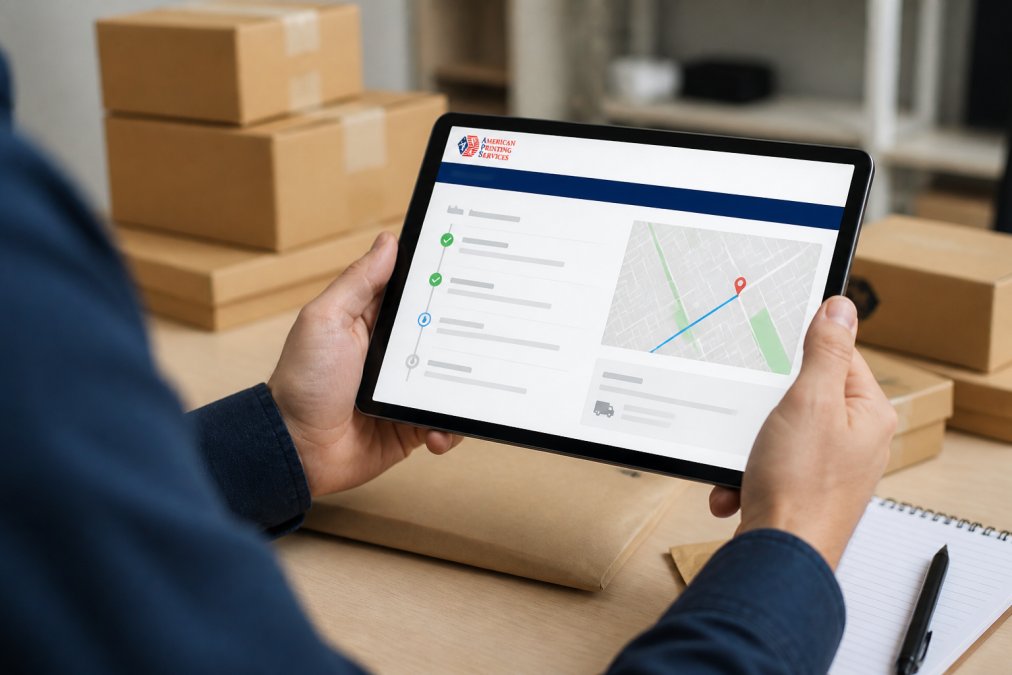
Real-time tracking transforms uncertainty into confidence. Start tracking from order placement. Your vendor should provide an order number and confirmation that your request entered their production queue within 24 hours.
Request production milestone updates: materials sourced, production started, quality control completed, packaged and ready to ship. These checkpoints catch problems early. If production hasn't started by day three of a 20-day lead time, you have time to investigate.
Once your order ships, check tracking information every two days as delivery approaches. This gives you time to address delays.
Set up automatic notifications from your logistics partner. Most carriers offer email or SMS alerts when shipments are picked up, in transit, out for delivery, and delivered. These eliminate manual checking.
For multi-location deliveries, create a tracking spreadsheet consolidating all shipment numbers, expected delivery dates, and addresses. This prevents losing track of individual shipments within larger orders.
Document actual delivery dates and compare them to planned dates. This historical record helps you understand your vendor's actual performance versus quoted lead times, invaluable for future planning.
Build Contingency Plans for Supply Chain Disruptions
Supply chain disruptions happen despite perfect planning. Vendor facilities experience downtime. Logistics providers encounter weather delays. Critical materials become temporarily unavailable. Your contingency plan prevents panic when these inevitable events occur.
Identify your highest-risk scenarios. What products would cause the biggest operational impact if delayed? Which locations or departments would be most affected? What's the financial consequence of missed deadlines? Once identified, you can plan around them.
For highest-risk items, build in extra lead time. If a product normally takes 15 working days, plan as if it takes 20. This buffer cushions unexpected delays.
Establish relationships with secondary vendors for critical items. You don't need to order regularly, but having a backup vendor for emergencies is invaluable insurance. If your primary vendor experiences a facility shutdown, you can pivot and minimize disruption.
Create a communication escalation plan. If your primary vendor might miss a deadline, who needs immediate notification? Who needs to know if delays extend beyond certain thresholds? Clear escalation prevents surprises.
Document contingency options in advance. If a shipment is delayed five days, what's your backup plan? Can you source an emergency shipment elsewhere? Can you delay the event? Can you use previous inventory temporarily? Having options documented means you execute quickly rather than scrambling.
Balance Quality Control and Speed
The tension between timely delivery and quality standards is real. You can't sacrifice quality to hit deadlines, but you can't let quality concerns delay orders indefinitely.
Establish clear quality standards upfront. What does acceptable color matching look like? What's your tolerance for minor printing imperfections? What constitutes a defective unit? Document and share these standards with your vendor before production begins.
Build quality checkpoints into your timeline. Request sample approval at early stages. For apparel, see a sample with exact specifications before full production. For printed materials, review color proofs before the full print run. Early checkpoints prevent discovering quality issues after thousands of units are produced.
Accept some quality issues to maintain timelines. A minor color variation barely noticeable to customers differs from unusable color mismatches. Know the difference. Rejecting orders for trivial issues means choosing to miss deadlines for problems that don't matter.
Communicate quality-versus-speed priorities clearly. If you have a hard deadline, tell your vendor: "We need this by October 15th. Quality matters, but timeline is non-negotiable. What's the best quality we can achieve within that constraint?" This honest conversation helps your vendor understand your actual priorities.
For rush orders, explicitly discuss quality implications. A 5-day turnaround instead of 20 days might mean fewer quality control iterations or less time for color matching. Make trade-offs consciously rather than discovering them when orders arrive.
Ensuring timely delivery of branded merchandise requires coordinated planning across demand forecasting, vendor communication, logistics partnerships, and contingency planning. The businesses that execute this best treat supply chain reliability as a core operational priority. American Printing Services, LLC brings 20 years of industry experience and a network of over 2,500 production facilities across North America to help you eliminate guesswork. Our team manages lead times, vendor coordination, and logistics tracking so your branded merchandise arrives when you need it. Get started with American Printing Services, LLC and transform your supply chain from a source of stress into a competitive advantage.
Frequently Asked Questions
Q: What does timely delivery mean in the commercial printing industry?
A: Timely delivery means your branded merchandise arrives on the agreed-upon date, ready for use. In commercial printing, this typically accounts for production time, quality checks, and shipping duration. For custom orders, timely delivery depends on complexity, quantity, and current production schedules. Working with vendors who provide clear delivery deadlines and on-time delivery rates helps set realistic expectations and prevents disruptions to your marketing campaigns or operations.
Q: How do branded merchandise lead times affect my order timeline?
A: Branded merchandise lead times determine how far in advance you must place orders. Lead times include design approval, production setup, manufacturing, quality control, and shipping. Custom items typically require 2-4 weeks or longer depending on complexity and volume. Understanding these timelines lets you plan campaigns and inventory accordingly. Work with vendors who provide detailed production schedules and buffer time for unexpected delays, ensuring your branded materials arrive when you need them.
Q: What steps can I take to mitigate supply chain delays?
A: Start with accurate demand forecasting to avoid rush orders that compress timelines. Establish clear communication channels with your vendors and confirm production schedules in writing. Choose logistics partners with proven shipping reliability and multiple distribution options. Maintain contingency plans, such as backup vendors or alternative products. Document all orders and track progress regularly. Build buffer time into your deadlines to accommodate unforeseen delays.
Q: How can I ensure color consistency across multiple branded merchandise orders?
A: Require your vendor to provide a pre-production approval checklist that includes color samples and specifications. Use standardized color codes (Pantone, CMYK) in all design files to ensure consistency. Request that all batches be produced in the same production run when possible. Establish a quality control process that inspects samples before full production begins. Ask your vendor about their color matching process and documentation accuracy standards. Regular communication and clear expectations reduce variations between batches and protect your brand visibility.
This article was written using GrandRanker