 how-to
Get a Quote for Bulk Print Projects: Complete Guide
Table of Contents
- What You Need Before Requesting a Bulk Print Quote
- Commercial Printing Cost Factors That Affect Your Quote
- Offset vs Digital Printing for Bulk Orders
- How to Request a Print Quote Template and Process
- Turnaround Times and Delivery Estimates
- Sustainability and Eco-Friendly Bulk Options
- Post-Quote Negotiation Strategies
- Checklist for Print-Ready Files
- Frequently Asked Questions
Last Updated: September 3, 2026
What You Need Before Requesting a Bulk Print Quote
Getting an accurate bulk print quote requires clarity about your project specifications. Too many businesses request quotes without defining their needs properly, leading to mismatched expectations and wasted communication. Before contacting a printer, know your specifications inside and out.
At American Printing Services, LLC, we work with hundreds of businesses annually requesting bulk print quotes. This upfront work saves time and ensures your quote reflects what you actually need.
Defining Your Project Specifications
Your project specifications form the foundation of any bulk print quote. Start with basic dimensions: trim size, number of pages, and total quantity. A 5x7 inch postcard printed 10,000 times is fundamentally different from an 8.5x11 inch brochure at the same quantity.
Define your color requirements: full-color four-color process (CMYK), spot colors, or black and white? Full-color jobs require different equipment and setup than single-color work. Document any special requirements like die-cuts, embossing, foil stamping, or custom shapes, these finishing options add cost but make materials stand out.
Finally, clarify delivery requirements. Do you need everything at once or in multiple shipments? One location or five retail stores? American Printing Services, LLC leverages a network of production facilities to handle multi-location delivery efficiently, but this needs to be part of your initial specifications.
Understanding Paper Stock and Weight
Paper choice affects both cost and quality perception. Paper weight is measured in gsm (grams per square meter) (iso.org). Common weights for marketing materials range from 80 gsm (thin) to 300+ gsm (premium cardstock). A 100 gsm paper feels flimsy; 200 gsm feels substantial and professional. For brochures, 150-200 gsm is standard; for business cards, 250+ gsm.
Coated stock (glossy or matte) reflects light and produces vibrant colors, ideal for photography-heavy materials. Uncoated stock absorbs ink and creates a natural, textured feel, preferred for corporate documents. Specialty papers like recycled, linen, or kraft cost more but communicate specific brand values.
When requesting your bulk print quote, specify the exact paper stock by name or ask the printer to recommend options within your budget. Include whether you want a coating applied (matte, gloss, or UV). These decisions directly impact your quote's line items and final quality.
Commercial Printing Cost Factors That Affect Your Quote
Five primary factors influence your bulk print quote: quantity, setup costs, paper selection, finishing options, and turnaround time.
Quantity creates economies of scale. Printing 1,000 items costs significantly more per unit than 10,000 because setup and design costs spread across more pieces. The cost difference between 5,000 and 10,000 units is smaller than between 1,000 and 2,000. Ask your printer for tiered quotes at different volumes to see where real savings kick in.
Setup costs include plate creation, color proofing, and equipment configuration. For offset printing, these are substantial and fixed regardless of quantity. For digital printing, setup costs are minimal but per-unit costs stay higher. This is why offset becomes more economical at higher volumes (typically 5,000+ units) while digital makes sense for smaller runs.
Binding and Finishing Options
Binding transforms a flat stack of paper into a professional product. Perfect binding (like a paperback book) uses adhesive and is ideal for brochures and catalogs. Saddle stitching (staples through the spine) works well for thin booklets. Comb binding, spiral binding, and wire-o binding are more durable for frequently handled documents. Each method requires different equipment and labor.
Finishing options add polish: lamination protects materials and adds sheen; UV coating provides a glossy finish on select areas; embossing creates raised impressions; foil stamping applies metallic accents; die-cutting creates custom shapes. Each increases cost but also increases perceived value.
When requesting your bulk print quote, list every finishing option you're considering. American Printing Services, LLC's experience means we can advise on which finishing techniques deliver the best return on investment for your materials.
Quantity and Volume Discounts
Most printers offer tiered pricing: 1,000 units at one price, 5,000 units at a lower per-unit price, 10,000 units lower still. When you request your bulk print quote, ask for pricing at multiple volume levels. This gives you real data to determine whether ordering now or combining orders makes financial sense.
Digital printing offers modest volume discounts because setup costs are low. Offset printing offers steeper discounts at higher volumes because fixed setup costs spread across more units. This distinction is critical when deciding whether to print 2,000 units digitally or wait and print 10,000 via offset.
Offset vs Digital Printing for Bulk Orders
The choice between offset and digital printing fundamentally changes your bulk print quote and timeline.
Offset printing uses metal plates and ink to transfer images onto paper. It requires significant setup but delivers consistent quality across thousands of impressions. Offset excels at high-volume runs (5,000+ units) where per-unit cost becomes highly competitive. Color consistency is excellent once the press is dialed in, which matters for branded materials.
Digital printing bypasses plate-making entirely. A digital printer reads your file directly and prints on demand. Setup is minimal, making digital economical for smaller runs (under 5,000 units). Quality is excellent, but color can vary slightly between print runs because there's no standardized press setup. For projects where color matching across multiple print dates is critical, this matters.
When requesting your bulk print quote, ask which method the printer recommends for your volume and materials. Some printers have both capabilities and will quote both methods so you can compare cost and timeline.
How to Request a Print Quote Template and Process
Requesting a bulk print quote doesn't require a formal template, but providing organized information accelerates the process and ensures accuracy.
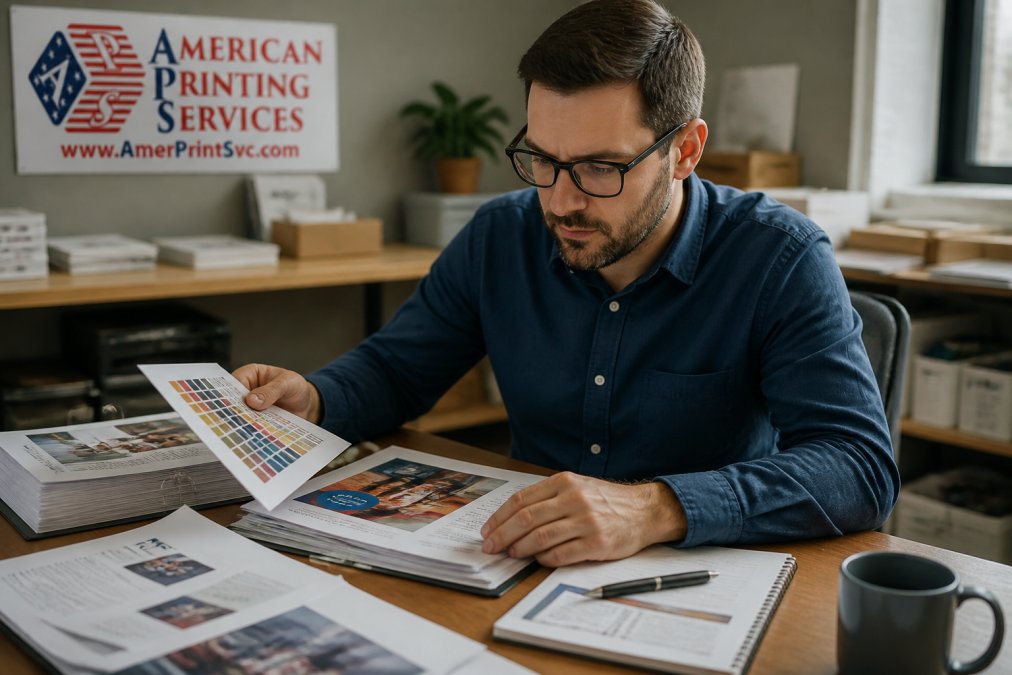
Compile your project information into a single document: project name, product type, quantity, trim size, number of pages, color specification (CMYK, spot color, black and white), paper stock and weight, binding method, finishing options, delivery location, and desired turnaround time. If you have a design file ready, mention the format (PDF, Adobe InDesign, etc.).
Include reference materials if available: a competitor's product you like, color samples, or a rough mockup. These visual references help the printer understand your vision.
Be specific about turnaround time. "ASAP" doesn't help; "Delivery by November 15th" does. Tight turnarounds sometimes require rush fees or limit which facilities can handle your job, both affecting your quote.
File Preparation and Print-Ready Requirements
Your file preparation determines whether the quote-to-production transition is smooth. Print-ready files save time and prevent costly mistakes.
A print-ready file meets these standards: 300 DPI resolution at final size, CMYK color profile (not RGB), all fonts embedded or converted to outlines, all images linked and included, and proper bleed allowance (typically 0.125 inches beyond trim size). Include crop marks and trim guides so the printer knows exactly where to cut.
When you request your bulk print quote, mention whether your files are print-ready or if you need the printer to prepare them. Print-ready files get quoted faster and more accurately.
Instant Pricing vs. Custom Estimates
Many printers offer online quote tools providing instant pricing for standard products. Others require detailed requests and custom estimates from a salesperson.
Instant pricing works well for standard products with limited variables: business cards, postcards, standard brochures. Custom estimates take longer but accommodate complexity and allow negotiation. If your project has unusual specifications or requires multi-location delivery, a custom estimate gives accurate pricing.
Consider which approach fits your timeline. For 24-hour quotes, use instant tools. For more time and exploration, request a custom estimate. American Printing Services, LLC handles both approaches.
Turnaround Times and Delivery Estimates
Turnaround time is one of the most important variables in your bulk print quote and affects cost.
Standard turnaround is typically 5-10 business days for offset printing, 2-5 business days for digital printing, assuming print-ready files and no rush service (printing.org). Rush orders (3-day or next-day turnaround) incur significant premiums because they disrupt the production schedule.
Delivery time is separate from turnaround time. Even if materials are printed in 5 days, shipping adds another 1-5 days depending on distance. Some printers can split shipments to different addresses.
When requesting your bulk print quote, specify your actual deadline. Padding your timeline with an extra week often eliminates rush fees, saving money.
Sustainability and Eco-Friendly Bulk Options
Sustainability increasingly affects customer perception and brand positioning. Many printers offer eco-friendly options that cost slightly more but align with corporate values.
Recycled paper stocks use post-consumer waste. FSC-certified papers come from responsibly managed forests (fsc.org). Soy-based inks replace petroleum-based inks. Water-based coatings replace solvent-based finishes. Each option increases cost marginally but communicates environmental commitment.
When requesting your bulk print quote, ask about sustainable alternatives. The cost difference is often 5-10% above standard options. American Printing Services, LLC works with production facilities across North America offering comprehensive sustainability options.
Post-Quote Negotiation Strategies
Your bulk print quote is a starting point, not a final offer. Many businesses accept the first quote without negotiation, leaving money on the table.
After receiving your quote, review the line items. Setup costs, per-unit costs, finishing charges, and shipping are all negotiation points. If setup costs seem high, ask if simplifying your design or reducing finishing options can reduce them.
Timing is a negotiation tool. If you can be flexible about when you need materials printed, printers may offer discounts for off-peak orders. If you're willing to commit to multiple orders over the next year, that qualifies you for volume pricing.
Consolidation is another strategy. Consolidating your volume with one vendor often qualifies you for better pricing. American Printing Services, LLC's network allows us to consolidate orders efficiently and pass savings to customers.
Finally, ask what you're not being charged for. Some printers include proofs, design revisions, and shipping; others charge separately.
Checklist for Print-Ready Files
Before submitting your bulk print quote request, verify that your files meet these requirements.
| Requirement | Check | Details |
|---|---|---|
| Resolution | ✓ | 300 DPI at final print size |
| Color Mode | ✓ | CMYK, not RGB |
| Fonts | ✓ | Embedded or converted to outlines |
| Images | ✓ | Linked and included in file package |
| Bleed | ✓ | 0.125" beyond trim size |
| Crop Marks | ✓ | Present and properly positioned |
| File Format | ✓ | PDF or native design file |
| Color Profile | ✓ | Matches printer's specifications |
| Margins | ✓ | No critical content within 0.25" of trim |
| File Size | ✓ | Under 500MB (confirm with printer) |
Run through this checklist before requesting your bulk print quote. If your files don't meet these standards, ask your printer for their specific requirements.
Getting a bulk print quote is straightforward once you understand what information printers need and what variables affect cost. The most successful projects start with clear specifications, organized file preparation, and realistic timelines. American Printing Services, LLC has helped businesses navigate this process. Our team can guide you through specification definition, recommend printing methods that fit your budget, and deliver quotes that reflect your actual project scope. Start by gathering your project details, prepare your files according to print-ready standards, and request your quote today. We'll ensure you get accurate pricing and production that meets your timeline and quality expectations.
Frequently Asked Questions
What information do commercial printers need for an accurate bulk print quote?
Commercial printers need your project specifications, including trim size, quantity, paper stock and weight (measured in gsm), color profile (CMYK or RGB), binding and finishing options (lamination, UV coating), resolution and DPI for images, file format, bleed and crop marks, and your desired turnaround time. The more detailed your specifications, the more accurate your quote will be. Providing a print-ready file with proper resolution (300 DPI minimum) and color profile ensures the printer can calculate costs precisely without revisions.
How does paper stock affect the cost of a bulk print project?
Paper stock directly impacts your unit cost. Heavier paper (higher gsm) and premium finishes cost more than standard options. Specialty stocks like cardstock or textured paper increase material costs. Bulk orders reduce per-unit pricing significantly, but the type of stock you choose matters more than quantity alone. Digital printing works best with standard stocks, while offset printing becomes more cost-effective for larger volumes on specialty papers. Your printer can recommend stock options that balance quality and budget.
What is the difference between digital and offset printing for bulk orders?
Digital printing is ideal for smaller quantities (under 5,000 units) with faster turnaround times and no setup fees. Offset printing becomes more economical for larger bulk orders (10,000+ units) because setup costs are spread across more units, reducing unit cost significantly. Offset also offers superior color consistency across batches and handles specialty papers better. For mid-range volumes, request quotes from both methods to compare final costs. Most commercial printers can advise which method delivers the best value for your specific project scope and timeline.
How can I reduce costs when requesting a bulk printing quote?
Increase your quantity to qualify for volume discounts and lower unit costs. Choose standard paper stocks over specialty options. Simplify binding and finishing (avoid lamination or UV coating if not essential). Request longer turnaround times to allow offset printing, which costs less per unit for large runs. Provide print-ready files to avoid pre-press charges. Consider eco-friendly options, which sometimes offer competitive pricing. Request instant quotes from multiple printers to compare pricing. Negotiate on delivery logistics or ask about seasonal promotions. Most commercial printers offer bulk discounts that improve significantly at 10,000+ units.
This article was written using GrandRanker