 comparison
TwoSidesPrint vs AmericanPrintAndApparel Comparison
Table of Contents
- TwoSidesPrint vs AmericanPrintAndApparel: Quick Comparison Table
- B2B Screen Printing vs DTF Transfers: What Each Printer Does Best
- Commercial Printing Services for Businesses: Beyond Apparel
- Bulk Custom Apparel Printing Pricing: How These Two Compare
- Durability, Wash Testing, and Print Quality on Different Garment Colors
- Scalability and Turnaround Time for Growing Apparel Brands
- Which Provider Fits Your Business? A Decision Framework
- Conclusion
- Frequently Asked Questions
Last Updated: September 17, 2026
TwoSidesPrint vs AmericanPrintAndApparel: Quick Comparison Table
Choosing between TwoSidesPrint and AmericanPrintAndApparel comes down to production model, not just price. TwoSidesPrint is a custom printing provider specializing in DTF transfers, personalized apparel, and design services for businesses and creators. AmericanPrintAndApparel is a wholesale-focused B2B partner built for bulk custom apparel, stickers, and corporate marketing materials at volume.
| Factor | TwoSidesPrint | AmericanPrintAndApparel |
|---|---|---|
| Core method | DTF transfers, custom apparel | Screen printing, bulk apparel, stickers |
| Best for | Small businesses, creators, small batches | Enterprises, retail chains, recurring bulk orders |
| Pricing model | Quote-based | Bulk/wholesale quote |
| Volume sweet spot | Small-batch and personalized | High-volume, multi-location |
| Transparency | Pricing not listed online | Pricing not listed online |
| Weakness | Not built for huge runs | Not built for single-item orders |
B2B Screen Printing vs DTF Transfers: What Each Printer Does Best
The two printing methods behind these providers serve different jobs, and picking the wrong one wastes money. Screen printing pushes ink through a mesh stencil onto the garment, which keeps cost-per-unit low on large runs of the same design. DTF transfers print a design onto a film, then heat-press it onto fabric, which handles full-color, high-detail artwork without per-color setup.
TwoSidesPrint's DTF Transfer Focus
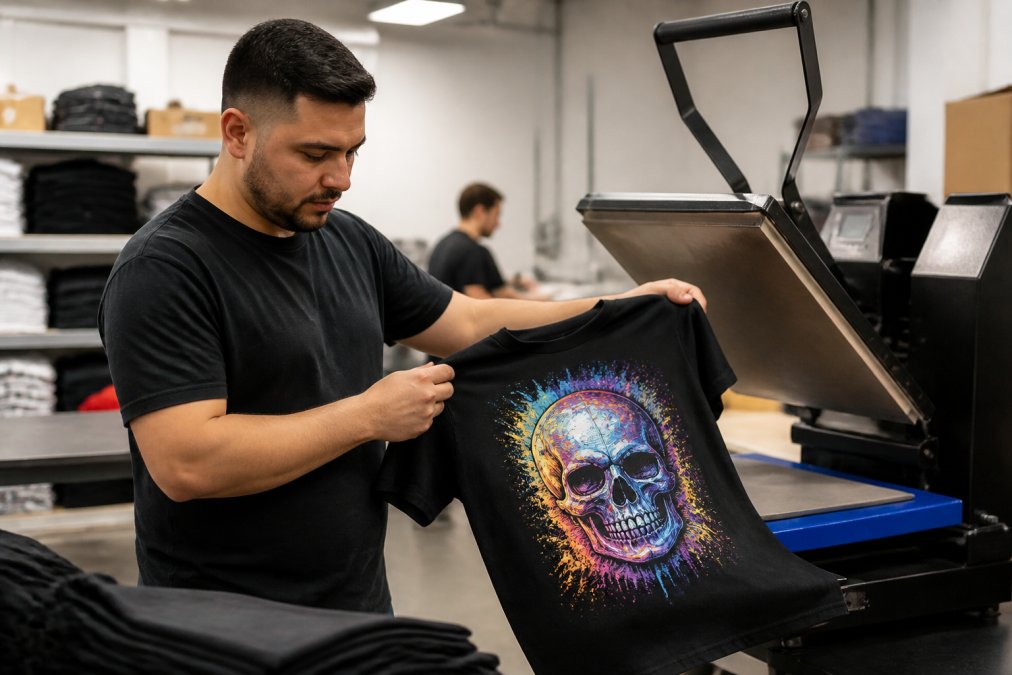
TwoSidesPrint leans into direct-to-film production. DTF suits vibrant design work, small-batch orders, and personalized apparel where setting up screens for every variant would be impractical. The trade-off is that film and transfer application add material cost per piece, so the method rarely wins on price at high volume.
AmericanPrintAndApparel's Screen Printing Volume Model
AmericanPrintAndApparel runs a screen printing volume model: wholesale pricing for large-scale corporate orders, multi-location rollouts, and recurring order management. Screen printed transfers reward repetition. The more units you print of one design, the lower the cost-per-unit falls. That model is built for retail chains and enterprises, not one-off orders.
Commercial Printing Services for Businesses: Beyond Apparel
Apparel is only part of the picture for commercial printing services for businesses. AmericanPrintAndApparel extends into stickers and corporate marketing materials alongside bulk custom apparel. That breadth matters when procurement wants one vendor for branded merchandise and operational print.
Bulk Custom Apparel Printing Pricing: How These Two Compare
Bulk custom apparel printing pricing depends on quantity, garment, print method, and turnaround, so both providers quote per project rather than publishing rates. That is normal for wholesale apparel work, and it means the honest answer is to request quotes on identical specs and compare totals. What separates a useful comparison from a useless one is understanding the cost mechanics underneath each quote, because the two methods do not scale the same way.
The Cost Mechanics Behind Each Method
Screen printing carries a fixed setup cost per color per screen, then a very low marginal cost per unit. That structure means the first dozen shirts of a design are expensive and the hundredth is cheap. DTF transfers invert part of that: there is no per-color screen setup, but every piece consumes film, adhesive powder, and press time, so the marginal cost per unit stays roughly flat no matter how many you run.
What Actually Moves Your Quote
- Quantity per design. Screen printing amortizes setup across more units; DTF does not benefit the same way. Splitting one 500-piece order into five 100-piece designs destroys the screen printing advantage.
- Number of colors and print locations. Each screen color and each print location (front, back, sleeve) adds setup on screen printing. DTF prices a full-color front print roughly the same as a one-color front print.
- Garment choice. Fabric and color affect both material cost and how well the print adheres. Dark garments require a white underbase on screen printing, which is effectively an extra screen.
- Order consolidation. Combining apparel, stickers, and collateral into fewer purchase orders cuts administrative and shipping cost.
- Turnaround. Rush timelines can add cost on either method; standard production windows are cheaper.
File Preparation: The Hidden Cost Driver
File prep is where quotes quietly diverge, and it is the step most buyers ignore. Screen printing generally wants vector art (AI, EPS, or PDF) with spot colors separated, because the artwork has to be output as individual film positives per screen. DTF accepts raster files more forgivingly, but quality still depends on resolution, 300 DPI at final print size is the working standard, and a 72 DPI web image scaled up will look soft no matter which method presses it.
Durability, Wash Testing, and Print Quality on Different Garment Colors
Wash durability and color vibrancy separate a good print from a great one, and garment background color changes the equation. DTF transfers lay a white ink base under the design, which keeps colors vibrant on dark garments where screen printing needs extra underbase passes. Screen printing tends to hold up well across repeated washes on high-volume runs when cured correctly.
Hand-Feel and Texture: What Each Print Actually Feels Like
Hand-feel is the sensory gap most comparisons skip, and it is often the deciding factor for retail apparel. Screen printing with a plastisol ink sits on top of the fabric as a slightly raised, rubbery layer. A thin deposit feels soft; a heavy deposit on a dark garment, where a white underbase is required, feels thicker and stiffer, especially across a large print area.
How to Run a Fair Wash Test
A single wash tells you almost nothing. A useful test controls the variables:
- Wash inside out in cold water on a normal cycle, then tumble dry low, this mirrors typical consumer care and is the baseline most apparel brands use.
- Run at least 10 to 20 cycles before judging, checking after cycles 1, 5, 10, and 20.
- Test the extremes of your line. Print on your darkest garment and your lightest garment, not just a white tee.
- Check the failure modes. On screen printing, look for cracking in thick ink deposits and fading on dark colors. On DTF, look for edge lifting, peeling at the corners of the transfer, and dulling of the white base.
- Compare like for like. Wash the same garment style, same design size, same care instructions for both methods.
Why Garment Color Changes Everything
On dark fabric, the challenge is opacity. Screen printing needs a white underbase to make colors pop, which adds a screen, adds cost, and adds thickness. DTF handles dark fabric more directly because the transfer carries its own white layer, so vibrant color on black or navy is a DTF strength. On light fabric, the risk flips: screen printing can show ink buildup that stiffens the hand-feel, and DTF can show a faint outline where the transfer edge sits against a light background.
Scalability and Turnaround Time for Growing Apparel Brands
Scalability is where these two providers diverge most. TwoSidesPrint scales across design variety: more SKUs, more personalized pieces, smaller runs. AmericanPrintAndApparel scales across volume: more units of fewer designs, distributed to multiple locations.
Which Provider Fits Your Business? A Decision Framework
Use this framework rather than guessing. It maps your order profile to the provider that fits:
| Your Situation | Better Fit | Why |
|---|---|---|
| Small batches, many designs | TwoSidesPrint | DTF handles detail and variety without screen setup |
| High-volume, one design | AmericanPrintAndApparel | Screen printing lowers cost-per-unit at scale |
| Multi-location enterprise rollout | AmericanPrintAndApparel | Built for bulk logistics and recurring orders |
| Personalized or custom design work | TwoSidesPrint | Design services and small-batch flexibility |
| Mixed apparel plus collateral | Either, or a single-source partner | Consolidation cuts coordination cost |
Conclusion
The twosidesprint vs americanprintandapparel comparison ends without a single winner because the two serve different order profiles. TwoSidesPrint wins on small-batch DTF work and design flexibility; AmericanPrintAndApparel wins on high-volume, multi-location screen printing.
Frequently Asked Questions
How does B2B custom printing differ from retail print-on-demand services?
B2B custom printing focuses on bulk orders, wholesale pricing, and recurring production for businesses, while retail print-on-demand handles single items with no minimums. B2B providers offer volume discounts, dedicated account management, and multi-location rollout capabilities. Retail POD services typically charge higher per-unit rates because they lack the economies of scale that come from high-volume production runs and wholesale supplier relationships.
How do screen printing and DTF transfer quality compare for bulk orders?
Screen printing produces thicker ink deposits with excellent color vibrancy on large runs, making it cost-effective for 50+ units. DTF transfers handle fine detail and gradient artwork better, with strong wash durability on cotton and poly blends. For bulk orders, screen printing usually wins on cost-per-unit, while DTF transfers offer more design flexibility without setup fees. The right choice depends on your design complexity and total quantity.
What factors should businesses consider when choosing a commercial printing partner?
Evaluate turnaround time, color consistency across batches, minimum order quantities, and whether the provider handles both apparel and marketing collateral. Multi-location businesses should confirm the partner can deliver to multiple addresses with consistent quality. Also check pricing transparency, onboarding speed, and whether the provider offers recurring order management for ongoing needs like branded forms, labels, and event materials.
What is the typical turnaround time for large-scale B2B apparel printing?
Standard turnaround for bulk custom apparel printing runs 7-14 business days after artwork approval, depending on quantity and decoration method. Screen printing requires setup time for each color, while DTF transfers skip screen setup and can move faster on smaller runs. Rush options exist but often carry surcharges. Confirm production timelines before peak seasons when demand spikes across the industry.
Are there specific benefits to using a national network for commercial printing?
A national production network reduces shipping times, maintains consistent supply during regional disruptions, and allows multi-location businesses to receive standardized materials from the nearest facility. This matters for retail chains needing identical signage, forms, or apparel across dozens of stores. It also provides backup capacity if one facility hits a bottleneck, keeping your deadlines intact during peak periods.
This comparison is published by American Printing Services, LLC. Pricing for both providers is quote-based; request current quotes directly for accurate figures.