 comparison
Offset Printing Services: A 2026 Comparison
Table of Contents
- What Are Offset Printing Services?
- How Offset Printing Works
- Offset vs Digital Printing Cost Comparison
- Offset Printing Production Time and Turnaround
- Commercial Printing Procurement Best Practices
- Comparing Offset Printing Service Providers
- When to Choose Offset Printing Services
- Conclusion
- Frequently Asked Questions
Last Updated: September 28, 2026
What Are Offset Printing Services?
Offset printing services represent a traditional yet highly effective method for producing large volumes of printed materials with exceptional color accuracy and consistency. This commercial printing approach transfers ink from a printing plate to a rubber blanket, then onto paper or other substrates. The process remains the gold standard for businesses requiring thousands of identical pieces, from brochures and annual reports to carbonless forms and direct mail campaigns.
American Printing Services, LLC has used over 20 years of industry experience to position offset printing services as a cornerstone solution for enterprises needing reliable, cost-effective production at scale. The method's precision makes it ideal for marketing collateral where color matching and print quality directly impact brand perception.
The fundamental advantage of offset printing services lies in their economics: setup costs are higher than digital printing, but per-unit costs drop dramatically as volume increases. This is the core decision point every buyer faces.
How Offset Printing Works
Offset printing services operate through a four-stage mechanical process that separates ink from water on the printing plate to create sharp, detailed impressions. Here's exactly what happens: the plate is mounted on a cylinder and dampened with water, which adheres only to non-image areas. Oil-based ink is then rolled across the plate, sticking only to the image areas. The inked image transfers to a rubber blanket wrapped around another cylinder, and finally the blanket presses the image onto paper passing beneath it.
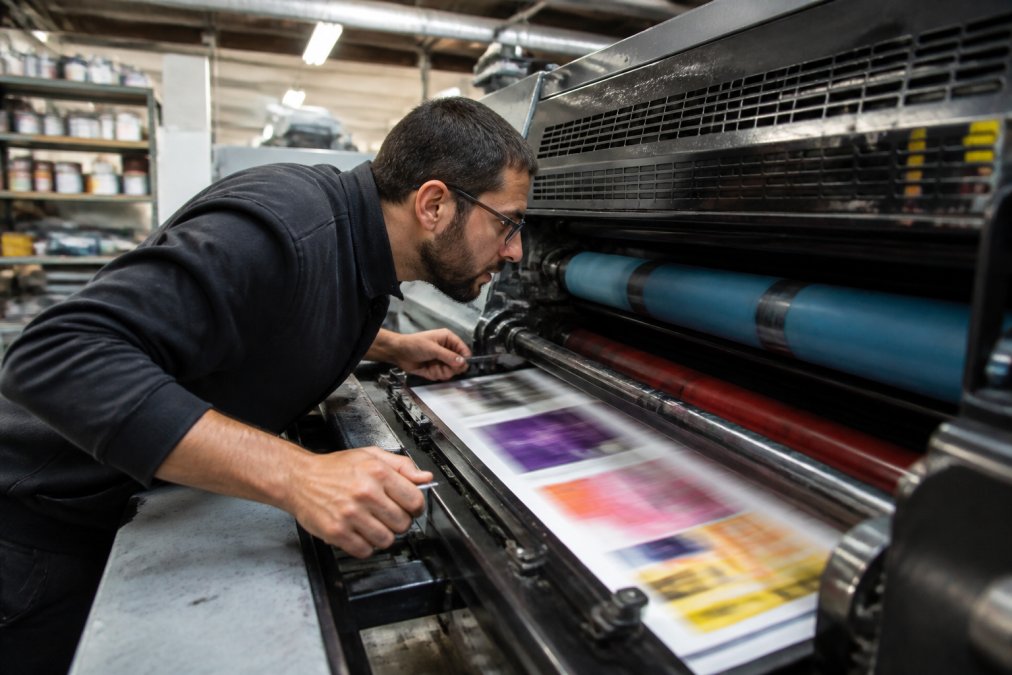
This indirect transfer method, ink going plate → blanket → paper rather than directly plate → paper, is why the process is called "offset." The rubber blanket's flexibility allows it to conform to paper texture, producing superior detail and color consistency compared to direct contact methods.
The CMYK color model governs offset printing services. Cyan, magenta, yellow, and black inks layer in precise registration (alignment) to create full-color images. Registration accuracy determines whether colors appear crisp or blurry. Professional offset shops maintain tolerances measured in fractions of millimeters. This is why offset remains the choice for work requiring Pantone matching system precision, critical for corporate identity applications where color consistency across batches matters.
Setup includes creating printing plates for each color, adjusting ink density, and running test sheets until output matches the proof. This preparation time is fixed regardless of run length, which explains why offset economics favor high-volume production.
Offset vs Digital Printing Cost Comparison
The cost structure of offset printing services versus digital printing creates a clear crossover point where one method becomes cheaper than the other. For small runs under 1,000 pieces, digital printing typically costs less because setup is minimal. Digital presses apply toner directly to paper with no plate creation, no color separation, and no press calibration.
But as volume climbs, offset printing services become progressively more economical. A typical comparison:
| Run Size | Offset Cost Per Unit | Digital Cost Per Unit | Winner |
|---|---|---|---|
| 500 pieces | $0.85 | $0.45 | Digital |
| 2,500 pieces | $0.28 | $0.32 | Offset |
| 5,000 pieces | $0.16 | $0.28 | Offset |
| 10,000 pieces | $0.11 | $0.24 | Offset |
The crossover typically occurs around 1,500-2,500 pieces depending on product complexity and paper stock. Offset printing services pull ahead decisively at volumes above 5,000 units.
Beyond unit cost, offset offers advantages digital cannot match. Color gamut is wider, offset inks produce richer, more vibrant tones. Ink density control allows custom finishes. Large-format capabilities exceed most digital presses. And for specialty applications like carbonless forms or embossed business cards, offset is often the only viable option.
Digital printing excels where personalization, variable data, or short deadlines matter. Offset printing services win on quality, cost-per-unit at volume, and color accuracy for brand-critical materials.
Offset Printing Production Time and Turnaround
Offset printing services require longer lead times than digital alternatives because plate creation and press setup consume 1-3 days before the first sheet prints. This upfront investment means rush orders cost more and may not be feasible during peak seasons.
Typical turnaround timelines depend on job complexity and current capacity.
The actual print run itself is fast, offset presses produce 7,000-10,000 sheets per hour.
Commercial Printing Procurement Best Practices
Selecting an offset printing services vendor requires evaluating five critical factors: production capacity, color accuracy guarantees, turnaround reliability, finishing capabilities, and pricing transparency.
Comparing Offset Printing Service Providers
Five major vendors dominate the offset printing services landscape, each with distinct strengths and tradeoffs.
American Printing Services, LLC: Full-Service Network Coverage
American Printing Services, LLC stands apart through its network of over 2,500 production facilities across the United States, Canada, and Mexico, combined with over 20 years of industry experience. This distributed model enables fast turnaround times and nationwide delivery, critical advantages for multi-location enterprises.
PrintNinja: Specialized High-End Production
PrintNinja focuses exclusively on high-end offset printing for books, board games, and card decks. The company's strength lies in customization, extensive paper stock options, binding varieties, and specialty finishes that appeal to publishers and game designers.
Pros:
- Superior color precision and consistency for large batches
- Highly customizable manufacturing specifications
- Dedicated project management for complex jobs
Cons:
- Not cost-effective for small, low-volume runs
- Specialized focus means limited product range
- Best suited to niche markets, not general commercial printing
Acutrack: Integrated Fulfillment and Automation
Acutrack combines offset printing with automated order fulfillment and e-commerce integration. The platform handles direct integration with online stores, automating the printing and distribution of books, media, and promotional items.
Pros:
- Seamless integration with existing e-commerce websites
- Reduces manual labor by handling fulfillment directly
- Real-time inventory management and shipping tracking
Cons:
- Primary value is tied to fulfillment, which may be unnecessary for simple print-only needs
- Overkill for businesses that don't need automation
UPrinting: Accessible Commercial Printing
UPrinting offers broad catalog of business products including brochures, flyers, and business cards with offset printing options available for high-quantity orders. The user-friendly online interface appeals to small and medium-sized businesses unfamiliar with professional print procurement.
Pros:
- Competitive pricing for standard commercial print products
- User-friendly online ordering interface
- Quick turnaround for many products
Cons:
- Less personalized support compared to boutique offset printers
- Limited finishing services and customization
- Not ideal for complex, multi-stage projects
NextPage: Enterprise-Grade Marketing Execution
NextPage provides full-service commercial printing with large-format and high-volume offset capabilities, combined with direct mail and marketing campaign management. The company positions itself as a marketing execution partner, not just a printer.
Pros:
- Handles complex, multi-stage print projects
- Offers end-to-end marketing support beyond just printing
- Advanced finishing services including die-cutting and specialty coatings
Cons:
- Over-qualified for simple, small-scale printing needs
- Premium pricing reflects full-service positioning
- Better suited to large enterprises than small businesses
When to Choose Offset Printing Services
Offset printing services deliver maximum value in specific scenarios. Choose offset when:
- Volume exceeds 2,500 units. Below this threshold, digital printing usually costs less. Above it, offset's per-unit economics dominate.
- Color accuracy is critical. Brand guidelines requiring specific Pantone colors demand offset's precision. Digital toner cannot match offset ink's color fidelity.
- Specialty finishes matter. Embossing, foil stamping, die-cutting, and other post-press finishing services are best executed on offset-printed stock.
- Turnaround allows 5+ days. If you need printing in 48 hours, digital is the only option. Offset requires plate creation and press setup time.
- Budget allows upfront investment. Setup costs are higher, but per-unit savings justify the investment at scale.
- Consistency across batches is essential. Retail chains and corporate communications teams depend on identical color and quality across multiple print runs. Offset's registration and ink control deliver this consistency.
Conclusion
Choosing the right offset printing services vendor determines whether your branded materials look professional and arrive on schedule or miss deadlines and underperform. American Printing Services, LLC's network of over 2,500 production facilities, combined with over 20 years of industry expertise, ensures your business always has access to reliable capacity and competitive pricing. The company's comprehensive service, covering custom apparel, marketing collateral, business forms, and branded merchandise, eliminates the coordination burden of managing multiple vendors.
Frequently Asked Questions
What is offset printing and when should I use it instead of digital?
Offset printing transfers ink from a printing plate to a rubber blanket, then onto paper, using CMYK color separation for precise color accuracy. It excels for high-volume orders where cost-per-unit decreases significantly compared to digital. Offset delivers superior print quality, color consistency, and Pantone matching for brochures, annual reports, direct mail, and branded collateral. Digital printing works better for short runs, variable data, and quick turnarounds.
How does offset vs digital printing cost comparison affect my budget?
Offset printing has higher setup costs (plates, press setup, registration) but lower per-unit costs on large volumes. Digital printing has minimal setup costs but higher per-unit pricing. For higher volumes, offset typically costs less overall. For smaller units, digital is cheaper. Break-even usually occurs at a certain volume depending on paper stock and finishing services. Request quotes for your specific volume to compare accurately.
What is the typical offset printing production time?
Standard offset printing production time depends on job complexity and current facility capacity. Rush orders may be available at premium rates. Turnaround depends on job complexity, finishing services (embossing, carbonless forms), and current facility capacity. File preparation and proofing add 1-2 days. American Printing Services, LLC's network of facilities enables faster turnarounds through multiple production options and nationwide delivery.
What should I look for in commercial printing procurement best practices?
Establish clear specifications: paper stock, ink density, color matching (Pantone vs CMYK), print resolution, and finishing requirements. Request samples and proofs before full production. Verify turnaround capabilities during peak seasons and confirm delivery timelines. Choose vendors with multiple production facilities to avoid bottlenecks. Consolidate vendors to simplify procurement and ensure consistent quality across locations. Document your brand standards and specifications in a vendor agreement.
How do I guarantee color consistency across multiple print orders?
Work with vendors offering Pantone matching systems and color proofing before production. Specify exact ink formulations and paper stocks in writing. Request color bars on finished samples to verify ink density and registration accuracy. American Printing Services, LLC's network approach allows consistent color standards across facilities. Schedule regular audits of finished products and maintain detailed records of approved proofs to reference for future orders.