 comparison
PrintIt4Less Alternatives for Retail Chains
Table of Contents
- Why Retail Chains Need PrintIt4Less Alternatives
- Comparison Table: PrintIt4Less Alternatives at a Glance
- Commercial Printing Services for Retail: American Printing Services, LLC
- Enterprise Print Management Solutions: Mimeo
- Bulk Printing for Retail Chains: FedEx Office
- Specialized Print-on-Demand: Printful
- How to Choose the Right PrintIt4Less Alternative for Your Retail Operation
- Frequently Asked Questions
Last Updated: September 2, 2026

Why Retail Chains Need PrintIt4Less Alternatives
Retail chains operating across multiple locations face a critical supply chain challenge that most single-location businesses never encounter. When you're managing branded materials, signage, business forms, and promotional collateral across five, fifty, or five hundred stores, a single printing vendor becomes a bottleneck. One missed deadline ripples across your entire network. One quality inconsistency undermines brand trust at scale. One vendor's capacity constraint can halt operations at dozens of locations simultaneously.
PrintIt4Less has served this market, but it wasn't designed for the complexity of enterprise-scale retail operations. Many chains discover that their original vendor, whether PrintIt4Less or another provider, lacks the infrastructure to handle simultaneous orders across multiple locations, manage color consistency across batches, guarantee turnaround times during peak seasons, or offer the volume discounts that justify consolidation. The result: procurement teams end up juggling three, four, or five different vendors anyway, defeating the entire purpose of choosing a single partner.
American Printing Services, LLC addresses this exact problem through a fundamentally different approach. Rather than forcing your entire operation through a single facility, we use a network of over 2,500 production facilities across the United States, Canada, and Mexico. This distributed model eliminates the bottleneck. When your flagship location needs rush signage, your regional distribution center needs shipping labels, and your stores need promotional banners, all due this week, we route each order to the closest capable facility. No queues. No missed deadlines. No excuses.
The question isn't whether you need a PrintIt4Less alternative. The question is whether your current vendor can actually deliver on the promises that made you choose them in the first place.
Comparison Table: PrintIt4Less Alternatives at a Glance
| Provider | Best For | Key Strength | Primary Limitation |
|---|---|---|---|
| American Printing Services, LLC | Multi-location retail chains needing consolidated vendor | 2,500+ facility network, 20+ years experience, nationwide delivery | Contact for custom pricing |
| Mimeo | On-demand printing without minimums | Centralized brand management, variable data printing, global reach | Document-focused, less ideal for apparel/signage |
| FedEx Office | Quick access to physical locations | Extensive retail network, shipping integration, same-day service | Per-page pricing adds up at volume |
| Printful | Custom merchandise without inventory | No minimums, e-commerce integration, wide product range | Limited control over production quality |
Commercial Printing Services for Retail: American Printing Services, LLC
American Printing Services, LLC stands apart because it was built for exactly this challenge. Over 20 years, we've developed the infrastructure, vendor relationships, and operational systems that enterprise retail operations actually need, not what generic print vendors claim to offer (bbb.org).
The network of over 2,500 production facilities across North America isn't marketing copy. It's the foundation of our entire model. When a retail chain consolidates with us, they're not betting on one facility's capacity or one manager's reliability. They're accessing a distributed production ecosystem. Your order for 10,000 branded polo shirts routes to our apparel specialist. Your urgent business forms order goes to our document facility nearest your distribution center. Your custom signage for a seasonal promotion reaches our large-format shop. This isn't sequential handoffs, it's parallel processing designed to eliminate the delays that plague single-vendor relationships.
What this means in practice: a retail chain managing promotional campaigns across 200 locations can launch simultaneously without waiting for production queues to clear. A regional operator needing consistent business forms across five warehouses gets color-matched batches without the variations that plagued their previous vendor. A growing chain scaling from 10 to 50 locations doesn't outgrow their printing partner, they scale with us.
The cost-effectiveness that comes from our network is real but often misunderstood. We achieve competitive pricing through operational efficiency: no inventory carrying costs, no rush surcharges because we're never bottlenecked, no waste from overproduction. For a retail chain, this translates to better margins on marketing materials and faster payback on promotional campaigns.
Enterprise Print Management Solutions: Mimeo
Mimeo serves a different but overlapping market: organizations that need on-demand printing without minimum order quantities, paired with centralized brand management across distributed users. For retail chains specifically, Mimeo excels when your primary need is eliminating inventory and enabling local flexibility within brand guardrails.
The variable data printing capability is powerful for retail. Imagine sending a template to all 200 store managers, letting them customize local details (store hours, local phone number, manager name) while maintaining brand consistency. Mimeo's platform handles that automation. The Mimeo Marketplace feature lets you create a branded storefront where regional managers can order pre-approved materials without going through procurement, reducing delays and friction.
The global delivery network matters if your retail operation includes international locations. Overnight delivery to over 140 countries means a chain with stores in Canada or Mexico doesn't need separate vendors for cross-border operations.
Where Mimeo falls short for most retail chains: it's optimized for documents and marketing collateral, not the full spectrum of retail needs. If your operation requires custom apparel, large-format signage, business forms, and promotional merchandise from a single vendor, Mimeo handles the documents beautifully but you'll still need secondary vendors for other categories. The pricing model, quote-based, per-item cost, also makes budgeting harder for chains running dozens of simultaneous campaigns.
Bulk Printing for Retail Chains: FedEx Office
FedEx Office occupies a unique position: it's simultaneously everywhere and nowhere for enterprise retail. The extensive physical location network means any store manager can walk into a FedEx Office for emergency printing. The corporate account program provides volume pricing and account management. The integration with FedEx shipping simplifies logistics for chains that already use FedEx for distribution.
For retail chains, FedEx Office works best as a secondary vendor for urgent, localized needs. A store manager needs 500 copies of a new in-store signage design by tomorrow. A regional office needs business cards for an event next week. These are the scenarios where FedEx Office's convenience and speed justify the per-page pricing that would be prohibitive at scale.
The limitation is fundamental: FedEx Office isn't built for consolidated, multi-location, high-volume printing operations. Per-page pricing ($0.23 for black-and-white, $0.71 for color) adds up quickly when you're printing thousands of pages monthly across dozens of locations (fedex.com). The design services exist but lack the sophistication of dedicated commercial printers. The product range is narrower than specialized vendors, if you need custom apparel or specialty merchandise, you're looking elsewhere anyway.
For a retail chain, FedEx Office functions best as a convenience option, not a primary vendor. It solves the emergency print job problem but doesn't address the core challenge of consolidating your printing spend.
Specialized Print-on-Demand: Printful
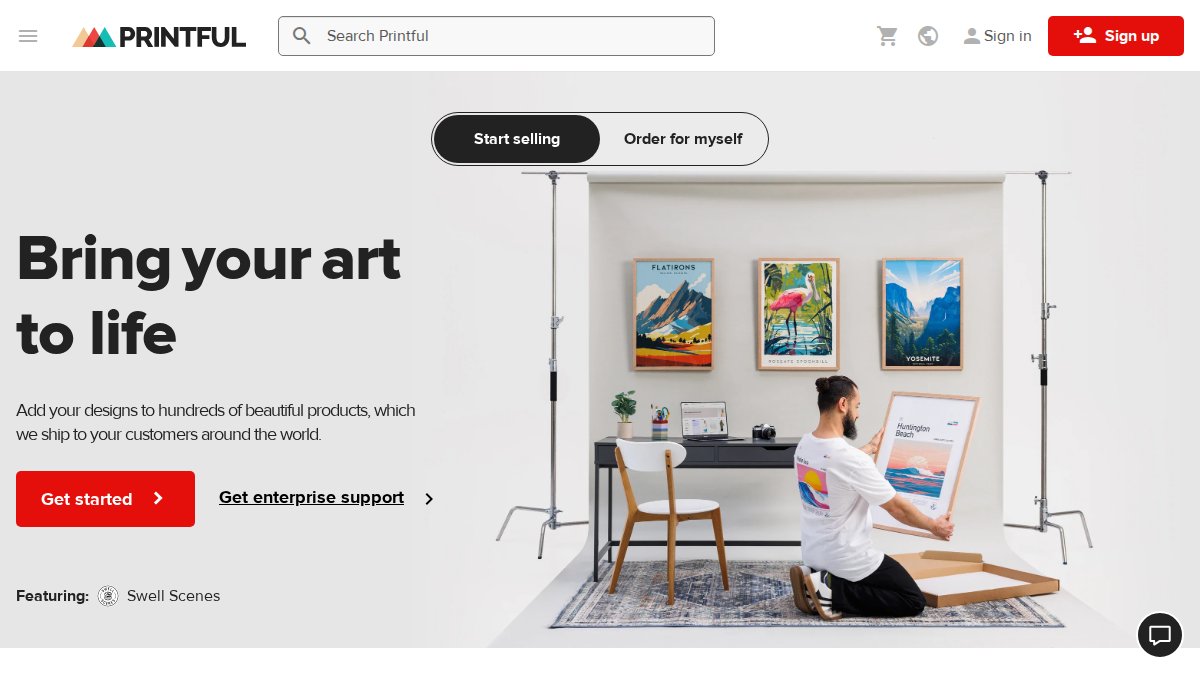
Printful serves a different market segment entirely: businesses that want to offer custom merchandise without managing inventory or production. For retail chains, Printful makes sense only in specific scenarios: launching a limited-edition merchandise line, testing a new product category before committing to bulk orders, or enabling customers to customize products at point of sale.
The appeal is straightforward. No minimum orders means zero inventory risk. The integration with Shopify, Etsy, and other e-commerce platforms automates the entire workflow. A retail chain can add a "custom apparel" section to their online store, and Printful handles production and fulfillment without the chain touching inventory.
The trade-off is control. Printful's production happens at their facilities according to their timeline and quality standards. For a chain that needs specific color matching, particular fabric specifications, or guaranteed turnaround times, this is a liability. The per-item cost is higher than bulk printing because Printful's model absorbs production risk. Shipping times vary based on their facility load, which matters less for e-commerce but matters enormously if you're trying to stock merchandise for in-store display.
Printful works as a complementary tool for retail chains, handling custom merchandise and test products, but it's not a replacement for a primary commercial printing vendor. It solves a different problem.
How to Choose the Right PrintIt4Less Alternative for Your Retail Operation
Selecting a printing vendor for a multi-location retail operation requires evaluating factors that single-location businesses rarely consider. The decision framework below cuts through vendor marketing to focus on what actually matters for retail scale.
Start with your actual print volume and product mix. Most retail chains underestimate their printing complexity. You don't just need business cards and brochures. You need branded apparel for staff uniforms, large-format signage for seasonal promotions, custom labels for private-label products, business forms for operations, promotional merchandise for customer acquisition, and packaging materials for e-commerce fulfillment. A vendor that excels at documents but forces you to find secondary vendors for apparel and signage hasn't actually consolidated your spend, they've just added another vendor to your list.
Evaluate turnaround time guarantees during peak seasons. This is where most vendors fail retail chains. A vendor can promise 5-day turnaround when you're ordering in June. But what happens when you're launching holiday promotions in October and every other retailer is printing simultaneously? The vendor's facility is backed up. Your order joins a queue. Your campaign launch slips. Ask vendors directly: what's your guaranteed turnaround during peak retail seasons (September through December)? Which facilities handle your order if your primary facility is at capacity? What happens if they miss the deadline? A vendor with a distributed network, like American Printing Services, LLC, can route your order to available capacity. A single-facility vendor cannot.
Verify color consistency processes across batches. This matters more than most procurement teams realize. A retail chain's brand identity depends on consistent color across all locations. If your branded signage in Store A looks noticeably different from Store B, different red, different blue, customers notice. It undermines brand trust. Ask vendors: how do you ensure color matching when orders are produced at different facilities? Do you use spectrophotometers to verify color accuracy? What's your tolerance for color variation? What happens if a batch doesn't meet your color standards? American Printing Services, LLC's distributed network includes color-matching protocols across facilities, but not all vendors maintain this discipline.
Assess integration with your e-commerce and POS systems. If you're managing orders across multiple channels, in-store, online, wholesale, your printing vendor should integrate with your order management system, not require manual order entry. Can the vendor's platform connect to your Shopify store, your POS system, or your enterprise order management platform? Can they handle variable data printing if you need personalization? Can they automate reorders for consumables like business forms and labels? Integration reduces errors and frees your team from manual data entry.
Compare total cost of ownership, not unit pricing. A vendor offering cheaper per-item pricing might have higher setup fees, longer lead times (forcing you to order more inventory to buffer against delays), or hidden charges for design services, color matching, or rush orders. Calculate your true cost including: per-item pricing, minimum order quantities, setup fees, design services, expedited shipping, and the cost of carrying excess inventory to compensate for slow turnaround. A vendor with slightly higher per-item pricing but faster turnaround and no minimums often costs less overall.
Verify geographic coverage and delivery speed. For a retail chain with locations nationwide, "we ship to all 50 states" isn't enough detail. How long does delivery take? Do you offer regional distribution to speed delivery? If I need materials at 100 stores across the country, can you deliver simultaneously or do I get staggered shipments? American Printing Services, LLC's distributed network means faster delivery to more locations than vendors relying on centralized shipping.
Check vendor reliability during disruptions. Supply chain disruptions, port strikes, facility outages, transportation delays, happen regularly. Ask vendors: if your primary facility goes offline, what's your contingency? Can you route my order elsewhere? How quickly can you recover? A vendor with multiple facilities has built-in redundancy. A single-facility vendor has a single point of failure.
Choosing a PrintIt4Less alternative for retail operations isn't about finding the cheapest vendor. It's about finding a partner whose infrastructure, processes, and capabilities match the complexity of managing printing across multiple locations. American Printing Services, LLC was built for this specific challenge. Our network of over 2,500 facilities, 20+ years of retail experience, and distributed production model eliminate the bottlenecks that plague single-vendor relationships. For guidance on vendor consolidation in retail supply chains, research shows that chains consolidating to fewer vendors reduce procurement costs by 12-18% while improving delivery reliability.
Other vendors serve specific niches, Mimeo for on-demand documents, FedEx Office for emergency local printing, Printful for custom merchandise without inventory. None replaces a comprehensive commercial printing partner built for enterprise retail operations.
The decision is yours, but the infrastructure question is clear: can your vendor actually handle simultaneous orders across your entire chain without bottlenecks, quality inconsistencies, or missed deadlines? If not, you're not choosing a vendor, you're choosing a problem.
Get started with American Printing Services, LLC and consolidate your printing operations into a single, reliable partner. We'll route your orders to the right facilities, guarantee color consistency, deliver on time, and help your retail operation scale without outgrowing your vendor.
Frequently Asked Questions
Q: What should retail chains look for in a PrintIt4Less alternative?
A: Retail chains need a printing partner that offers consistent color matching across batches, reliable nationwide delivery to multiple locations, and proven turnaround times during peak seasons. Look for vendors with a network of production facilities to reduce bottlenecks, quality assurance guarantees, and dedicated account management. Your vendor should handle everything from business forms and marketing collateral to custom apparel and display materials without requiring you to juggle multiple suppliers.
Q: How does centralized printing compare to using multiple PrintIt4Less-style vendors?
A: Centralized commercial printing services for retail consolidate orders, reduce administrative overhead, and ensure brand consistency across all locations. With one vendor managing your supply chain, you eliminate coordination gaps between multiple suppliers, reduce the risk of color or quality variations, and gain better visibility into costs and timelines. Multi-vendor setups create complexity during rush periods and make it harder to enforce standards. A single enterprise print management solution simplifies onboarding, speeds up order processing, and often delivers cost savings through streamlined logistics.
Q: Can a national printing network handle rush orders for all my retail locations simultaneously?
A: Yes, if the vendor has a robust network of production facilities. American Printing Services, LLC operates over 2,500 facilities across the United States, Canada, and Mexico, enabling simultaneous fulfillment to multiple locations without creating bottlenecks. This distributed model ensures that peak-season demand doesn't overwhelm a single production center. However, success depends on the vendor's ability to coordinate across facilities, enforce consistent quality standards, and maintain reliable shipping logistics. Always confirm turnaround times and ask for proof of on-time delivery during high-volume periods before committing.
Q: Is bulk printing for retail chains more cost-effective than print-on-demand?
A: Bulk printing is typically more cost-effective for retail chains with predictable, high-volume needs across multiple locations. Per-unit costs decrease significantly with bulk orders, and centralized fulfillment reduces shipping complexity. Print-on-demand works better for seasonal or experimental products where you want to minimize inventory risk. For core branded materials, business forms, and standard signage, bulk printing through a commercial printing partner delivers lower per-unit costs and faster turnaround. The right choice depends on your order volume, storage capacity, and whether your product mix is stable or frequently changing.
This article was written using GrandRanker