 listicle
Benefits of Multi-Location Printing Services
Table of Contents
- What Multi-Location Printing Services Deliver
- Cost Savings and Predictable Budgeting Across Locations
- Fast Turnaround Commercial Printing Services for Every Site
- Brand Consistency in Multi-Site Marketing Materials
- Reducing Shipping Costs for Business Printing
- Centralized Print Management and Workflow Optimization
- Security, Compliance, and Operational Consistency
- Frequently Asked Questions
Last Updated: September 1, 2026
What Multi-Location Printing Services Deliver
Multi-location printing services solve a fundamental problem for growing businesses: maintaining consistent branded materials across dozens of sites without drowning in logistics. American Printing Services, LLC specializes in exactly this challenge, using a network of over 2,500 production facilities across North America to ensure your business maintains quality and speed no matter how many locations you operate.
When you're running multiple retail stores, regional offices, or franchise locations, each site needs materials, business forms, promotional items, and signage. Ordering separately from different vendors creates inconsistency, higher costs, and unpredictable delivery times. Multi-location printing services centralize this entire operation into a single workflow, routing orders intelligently through the nearest facility to minimize delays and shipping expenses.
The real value is control. A single partner managing your print infrastructure means standardized quality across all locations, predictable budgeting, and the ability to respond quickly when one site needs urgent materials. You have one partner accountable for consistency and delivery.
Cost Savings and Predictable Budgeting Across Locations
Centralized purchasing power directly reduces your per-unit costs. When you consolidate all your printing volume with a single partner, you unlock volume discounts that individual locations could never negotiate independently. A provider with access to a vast network of facilities can route your jobs to the most cost-effective production center for each order, balancing quality, speed, and price automatically.
Predictable budgeting becomes possible with one partner on consistent terms. Instead of managing separate invoices from multiple vendors with varying rates and minimum order quantities, you work with one partner. Your finance team gets cleaner reporting and better visibility into print spend across all locations.
Shipping costs drop substantially when a single provider manages your multi-location distribution. Rather than shipping from a single central facility to every location or each location ordering locally, a distributed network routes jobs to the closest production facility. A retail chain ordering signage for 30 stores doesn't pay to ship from one place to all 30 (the CDC). Materials print closer to where they're needed, cutting both shipping time and cost.
Redundant production capacity across multiple facilities means one facility's downtime doesn't halt your entire operation. If a location's usual printer goes down during peak season, your order routes to the next available facility. That resilience eliminates missed deadlines, emergency rush fees, and lost sales.
Fast Turnaround Commercial Printing Services for Every Site
Speed becomes a competitive advantage when you're managing multiple locations. A single vendor with distributed production capacity delivers genuinely fast turnaround times even during peak seasons while accommodating hybrid and remote work patterns.
When demand spikes across all your locations simultaneously, a distributed network absorbs that volume without choking. A rush job for one location routes to an available facility that can handle it immediately, while routine orders for other locations process through standard channels. This parallel processing capability is impossible with a single-facility printer.
Multi-location printing services solve a critical problem in hybrid environments: remote employees can submit orders through a centralized portal that routes to the nearest facility. This eliminates the friction of remote workers being unable to access local printing or having to route all orders through a central location that then ships everything out.
Instead of waiting for materials to ship cross-country from a central facility, items print and ship from locations closer to their destination (the NIH). A marketing manager in Denver ordering branded apparel for an event doesn't wait for materials to come from the East Coast. They arrive faster, enabling tighter planning windows and fewer inventory carrying costs.
| Scenario | Single Vendor (One Facility) | Multi-Location Network | Hybrid-Enabled Network |
|---|---|---|---|
| Peak season rush | Long queue, extended lead times | Parallel processing, maintained turnarounds | Same + remote order routing |
| Remote employee order | Must route through main office or wait | Submits through portal, prints nearby | Prints at nearest facility, local pickup |
| Urgent single-location order | Full rush premium applied | Routes to available facility, lower premium | Same + hybrid flexibility |
| Cross-country delivery | 5-7 days standard | 2-3 days standard | 2-3 days + hybrid options |
| Inventory carrying costs | Higher (order larger quantities for safety stock) | Lower (faster replenishment available) | Lower + distributed pickup reduces central stock |
Implementation note: When evaluating multi-location providers, confirm they offer cloud-based ordering portals that support hybrid workflows, including the ability for remote employees to specify pickup locations and for the system to automatically route orders to the nearest production facility based on delivery address or designated pickup point.
Brand Consistency in Multi-Site Marketing Materials
Consistency is where many multi-location businesses stumble. One site's brochures have slightly off colors. Another location's business cards use a different font size. Signage across your retail chain looks like it came from different companies. These inconsistencies erode brand trust because different vendors interpret specifications differently with no centralized quality control.
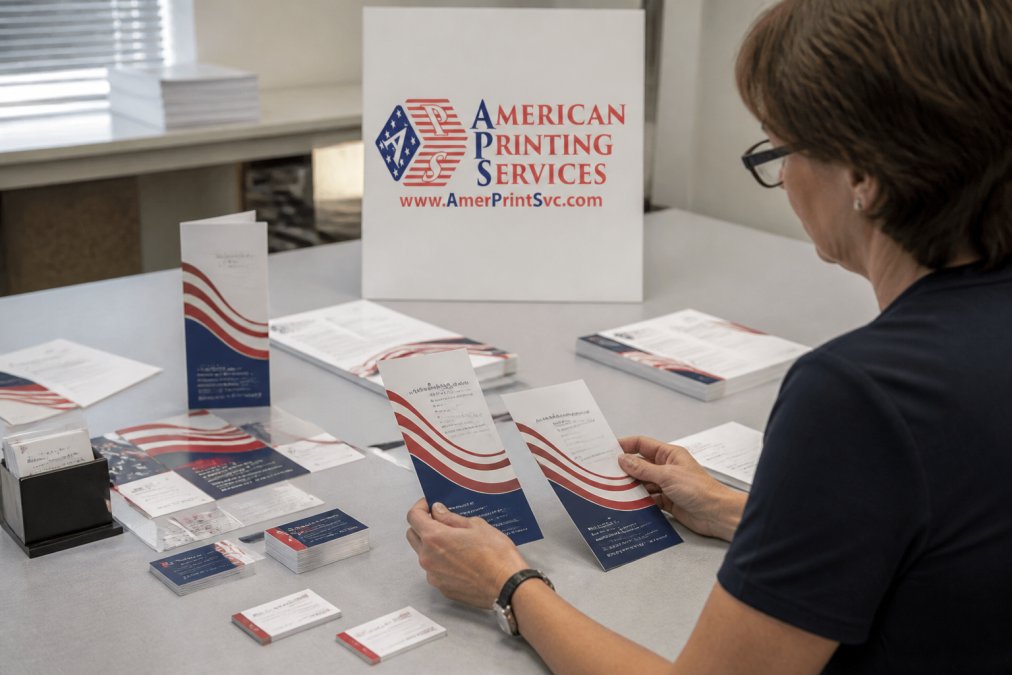
A centralized multi-location printing partner eliminates this problem. All materials print from standardized specifications using the same color profiles, approved templates, and quality benchmarks. Your brand looks identical whether a customer picks up a business card in Chicago or receives a mailer in San Francisco.
Quality control becomes systematic rather than reactive. A centralized partner monitors every production run against your specifications, catching issues before materials ship. If a batch of branded apparel has a color variance, you catch it at one facility before it reaches multiple locations.
Reducing Shipping Costs for Business Printing
Shipping is often the invisible cost killer in multi-location printing. When each site orders independently from distant vendors, or when a central vendor ships to dozens of locations, transportation expenses compound.
A distributed production network inverts this equation. Jobs route to the facility closest to their destination, cutting shipping distances dramatically. A marketing manager in Denver ordering branded materials doesn't pay to ship from the East Coast. Materials print in Denver or nearby, ship locally, and arrive faster and cheaper. Multiplied across dozens of locations and hundreds of orders annually, the savings are substantial.
A multi-location provider can consolidate orders from multiple sites into a single shipment when they're going to the same region or nearby locations. One shipment to a regional warehouse serves five locations instead of five separate shipments. This consolidation happens automatically through the provider's network optimization, but the cost savings flow directly to your bottom line.
Reducing shipping costs also reduces environmental impact (the EPA). Fewer shipments, shorter distances, and optimized routes improve your carbon footprint while cutting expenses.
Centralized Print Management and Workflow Optimization
Managing print across multiple locations typically means managing multiple vendors, ordering systems, invoicing processes, and quality standards. Centralized print management through a single partner collapses this complexity into a unified workflow.
A centralized system means one ordering platform for all locations. Your managers don't learn multiple vendor portals. They place orders through one interface, track status in one place, and manage approvals in one workflow. This simplification reduces errors and miscommunication.
Centralized inventory visibility prevents stockouts. You can see what's in stock across all locations, what's on order, and what's in production. If one site is running low on branded apparel, you know immediately and can route production to meet demand before they run out.
Measuring Success: Scalability Metrics and KPIs
When you add a new location to a centralized printing system, track these KPIs:
-
Order fulfillment time by location: Consistent delays signal routing inefficiency.
-
Cost per unit by location: Persistent premiums indicate suboptimal routing.
-
Inventory carrying costs: Centralized systems can help reduce this compared to independent ordering through faster replenishment.
-
Vendor management overhead: Consolidating from multiple vendors to one can reduce this.
-
Print quality defect rate: Centralized quality control aims to keep this low.
-
Order accuracy: Aim for high accuracy in delivery exactly as specified.
Change Management: The Human Element
Transitioning to centralized printing requires managing employee behavior change. Managers at each location may resist changing how they've always ordered printing.
Successful implementations address this directly:
-
Pilot with early adopters: Start with 2-3 locations whose managers are comfortable with change. After 30-45 days, they become advocates for other locations.
-
Provide location-specific training: Train managers on how the centralized system handles their specific use cases, whether retail signage or corporate business forms.
-
Establish a transition period: Run parallel systems for 60-90 days to give locations confidence before full commitment.
-
Create a feedback loop: Assign an internal champion at each location who reports issues back to your central procurement team.
-
Communicate benefits clearly: Show concrete examples: "Orders now arrive in 3 days instead of 5" or "We're saving 15% on per-unit costs."
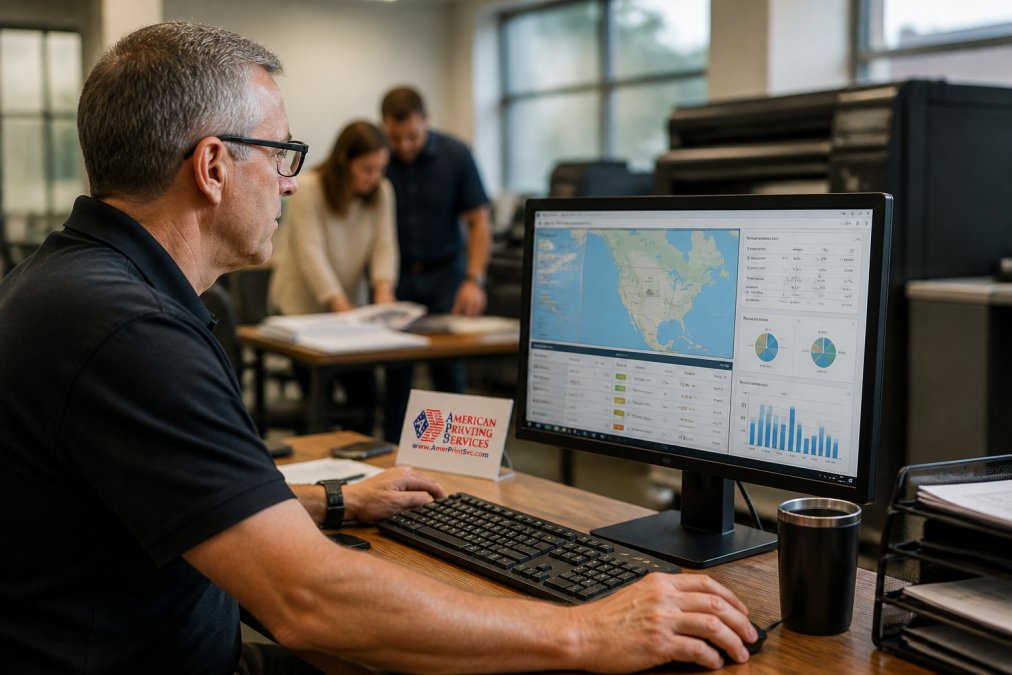
Workflow optimization extends to compliance and security. A single partner can help manage driver and firmware updates across your entire print fleet, ensuring all devices run current software. A centralized system can help enforce document security standards, user authentication, and audit trails.
Security, Compliance, and Operational Consistency
Print security is critical for multi-location businesses. Each device represents a potential vulnerability if not properly managed. Centralized print management means systematic security enforcement across all locations.
A single partner managing your print infrastructure ensures consistent security policies. User authentication is standardized, the same credentials work across locations, and access is controlled centrally. Sensitive documents are encrypted in transit and at rest. Print jobs are logged and auditable, creating a compliance trail when needed.
Compliance becomes simpler with centralized management. If you operate in regulated industries, healthcare, finance, legal, a centralized partner ensures all locations meet the same data protection standards, retention policies, and audit requirements.
Operational consistency means standardized processes across all sites. Every location follows the same workflow for ordering, approving, and receiving materials. Managers can move between locations and immediately understand how printing works. New locations can be onboarded quickly because they adopt the same system as existing sites.
When a location's printer breaks down, a centralized partner has contingency plans. Backup devices are available. If a facility goes down, orders route to the next available location. Your business doesn't halt because one printer failed.
Multi-location printing services solve the core tension of scaling a business: maintaining consistency and control while reducing costs and complexity. American Printing Services, LLC's network of over 2,500 production facilities across North America is built exactly for this challenge. We consolidate your vendor relationships, centralize your ordering and compliance, and route your jobs intelligently to balance speed, quality, and cost. Whether you're managing five locations or fifty, a single printing partner eliminates the coordination nightmare and gives you predictable, reliable execution. Get started with American Printing Services, LLC and transform how your business manages printing across all your locations.
Frequently Asked Questions
Q: What are the primary cost-saving benefits of multi-location printing services?
A: Multi-location printing services consolidate orders across all your sites, which reduces per-unit costs through higher volume discounts. By routing orders to the closest production facility in the network, you lower shipping expenses significantly. Centralized management also eliminates duplicate vendor relationships and redundant administrative overhead. You gain visibility into total print spend across locations, making it easier to identify waste and negotiate better rates. These services can lead to significant savings compared to managing separate vendors at each location.
Q: How do multi-location printing services ensure brand consistency across all sites?
A: A unified printing partner maintains standardized color profiles, fonts, and design specifications for all your branded materials, regardless of production location. Every order uses the same quality controls and approval processes, preventing variations between batches or locations. Centralized asset management keeps your brand guidelines in one place, so all locations access current logos and templates. This eliminates the confusion and cost of reprinting materials that don't match your brand standards. Consistent branding strengthens customer recognition and trust across your entire multi-site operation.
Q: Can multi-location printing services handle rush orders during peak seasons?
A: Yes. A network of production facilities spread across multiple regions means orders can be routed to the facility closest to each location, reducing production bottlenecks during high-demand periods. If one facility reaches capacity, orders automatically distribute to others in the network without delay. This distributed approach prevents the single-point-of-failure risk that occurs when you rely on one vendor. Multi-location providers are designed to handle seasonal spikes without missing deadlines.
Q: What happens if I need different printing services at different locations?
A: Multi-location printing services handle diverse needs through a single account. Some locations might need custom apparel and promotional items, while others require business forms, invoices, or marketing collateral. A comprehensive provider offers all product categories and routes each order to the facility best equipped for that specific service. You maintain one relationship, one billing process, and one contact for all services across all locations, which simplifies procurement and reduces onboarding time compared to juggling multiple vendors with different capabilities.
This article was written using GrandRanker